






Amrita Bakshi PhD Candidate · English
Research Teaching Publications Awards & Service Contact CV ↓
Doctoral Candidate in English Literature · The University of Alabama

A poetics tuned
to sound:
Reading modernism by ear.

I work at the meeting point of poetry and music — reading twentieth-century verse, with Marianne Moore at its center, through the avant-garde and the philosophy of sound. I am also interested in the study of postcolonial theory, posthumanism, and comparative literature.

Explore my research → Download CV
Amrita Bakshi in New York City
My work listens for the music of modern poetry — the sound, rhythm, and dissonance that make meaning as much as words do.
About

I am a PhD candidate (ABD) in English Literature at The University of Alabama, expected to graduate in May 2027. My scholarship centers on modernist poetry and poetics — most closely the work of Marianne Moore — and extends to the avant-garde, the relationship between poetry and music, Victorian temporalities, and postcolonial, posthumanist, and comparative frameworks across global Anglophone literature.

Alongside my research, I am a dedicated teacher and mentor. I have guided more than 150 students in composition and literature, designing curricula that foreground critical thinking, close reading, and cultural competence across diverse literary traditions.

Currently
Completing the dissertation on music and sound in Marianne Moore's poetics. On the 2026–27 academic job market.
Fields
Modernism Poetry & Poetics Marianne Moore The Avant-Garde Postcolonialism Posthumanism Global Anglophone

Recent Research Highlights

All publications & talks →
2026 · Article
"When 'Beyond-Human' is 'Becoming-Human': An Ustopian Paradox in Margaret Atwood's Oryx and Crake"
Interconnections: Journal of Posthumanism
Oct 2025 · Stanford
"A Soft Uninvented Music: Marianne Moore's Orchestra of Acoustic Metaphors and Authentic Sounds"
Marianne Moore Generations Conference — co-winner, Flash Panel
Apr 2025 · Dublin
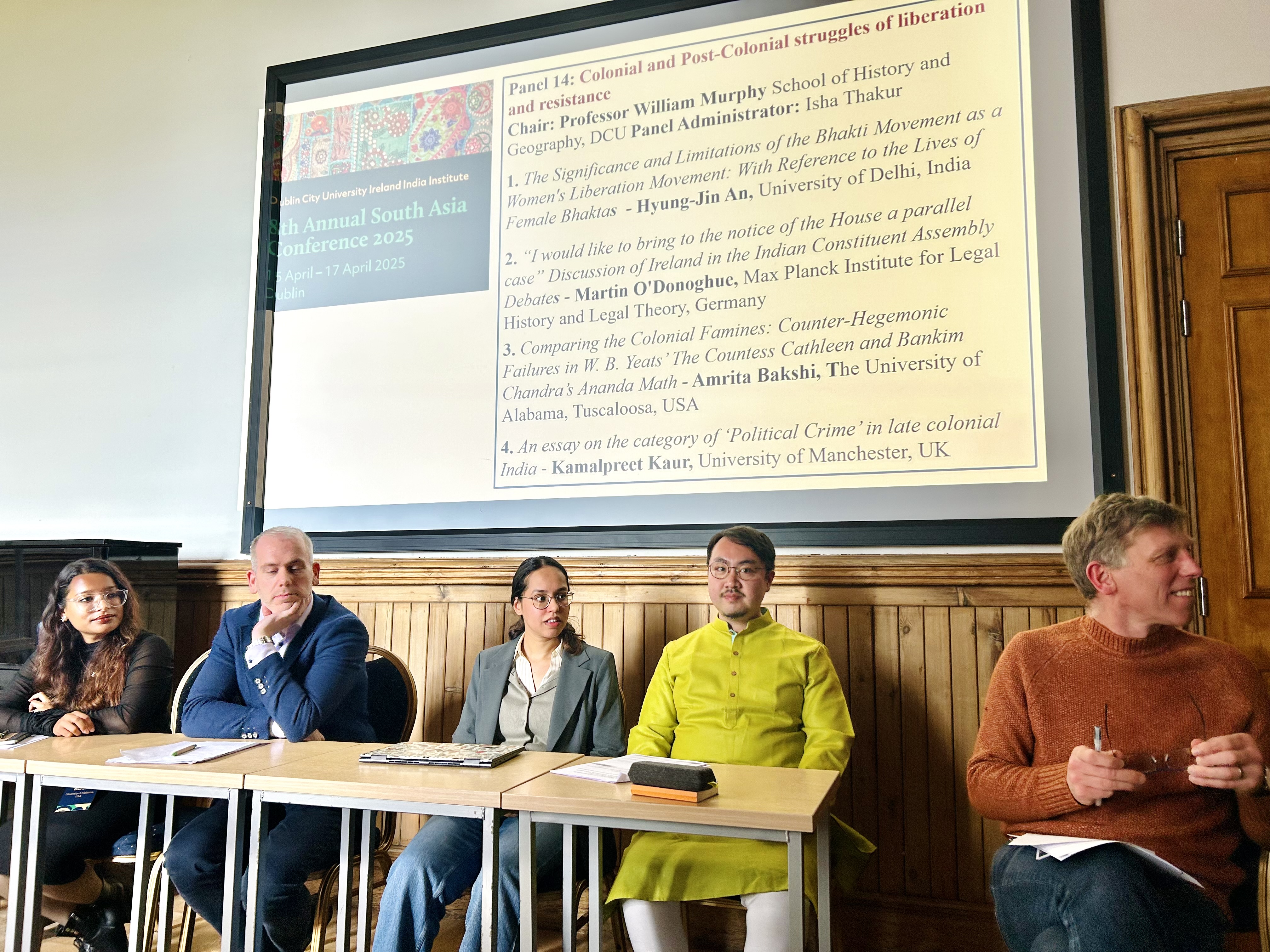
"Comparing the Colonial Famines: Counter-Hegemonic Failures in Yeats' The Countess Cathleen and Bankim Chandra's Ananda Math"
8th Annual South Asia Conference, Dublin City University
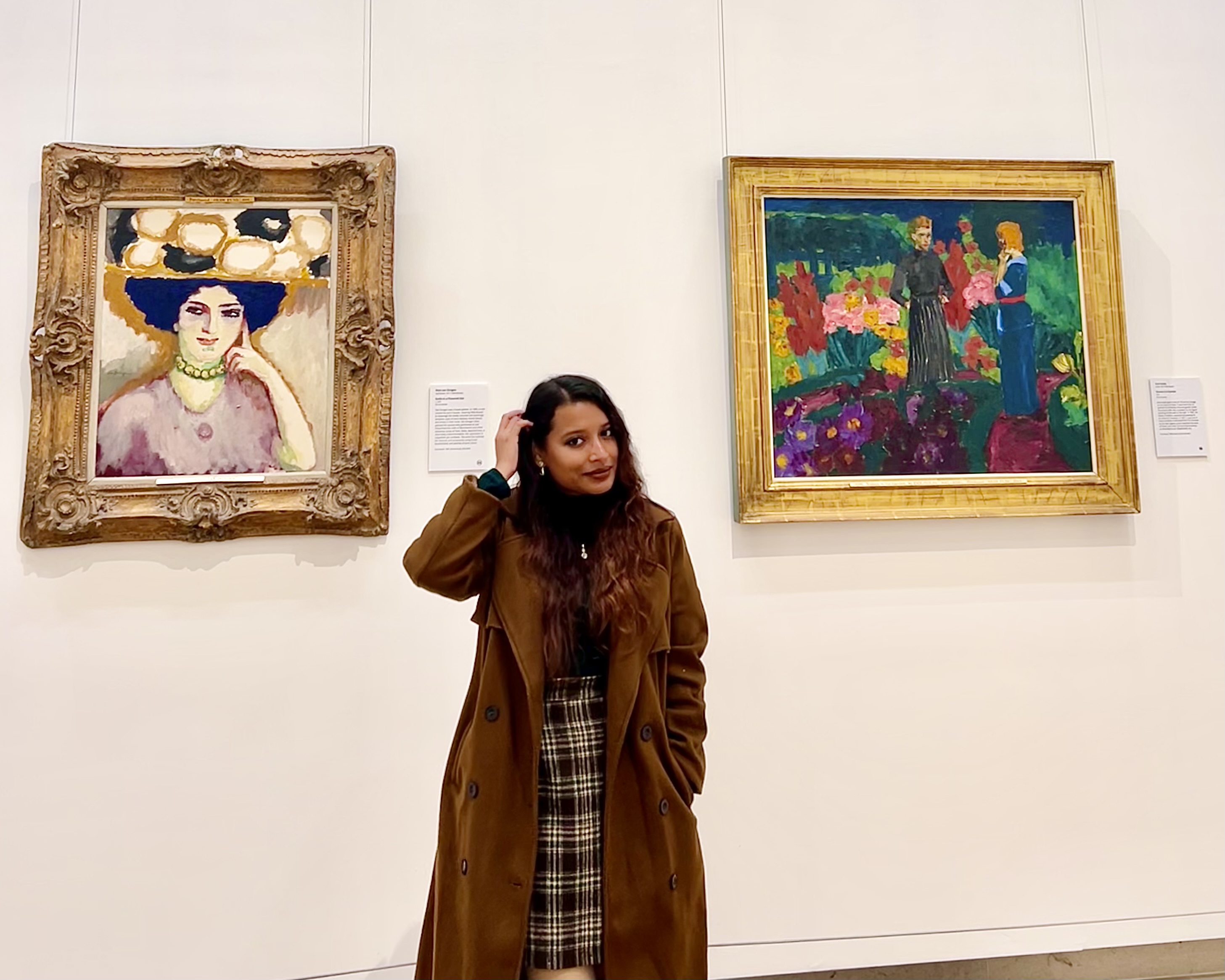
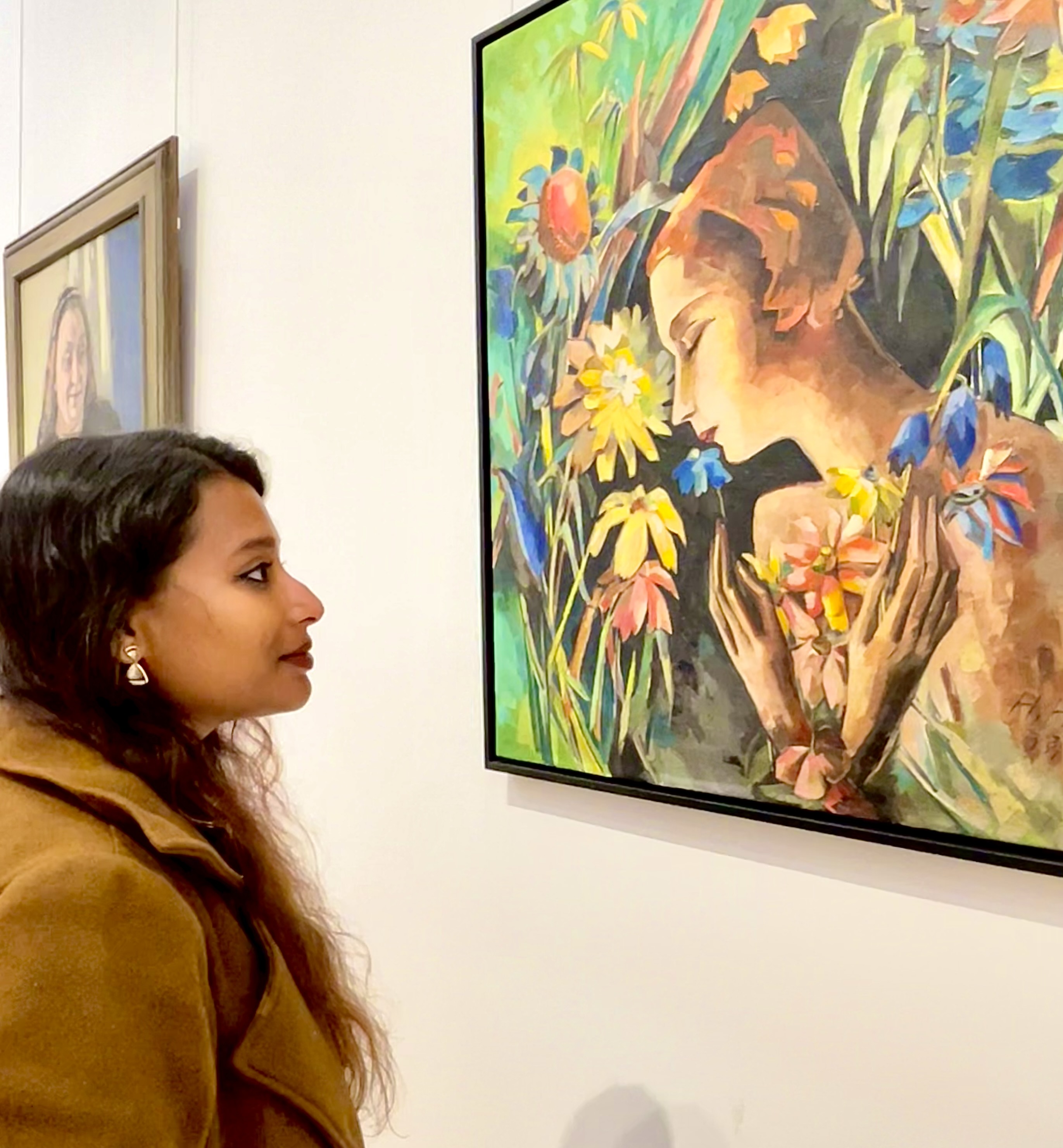
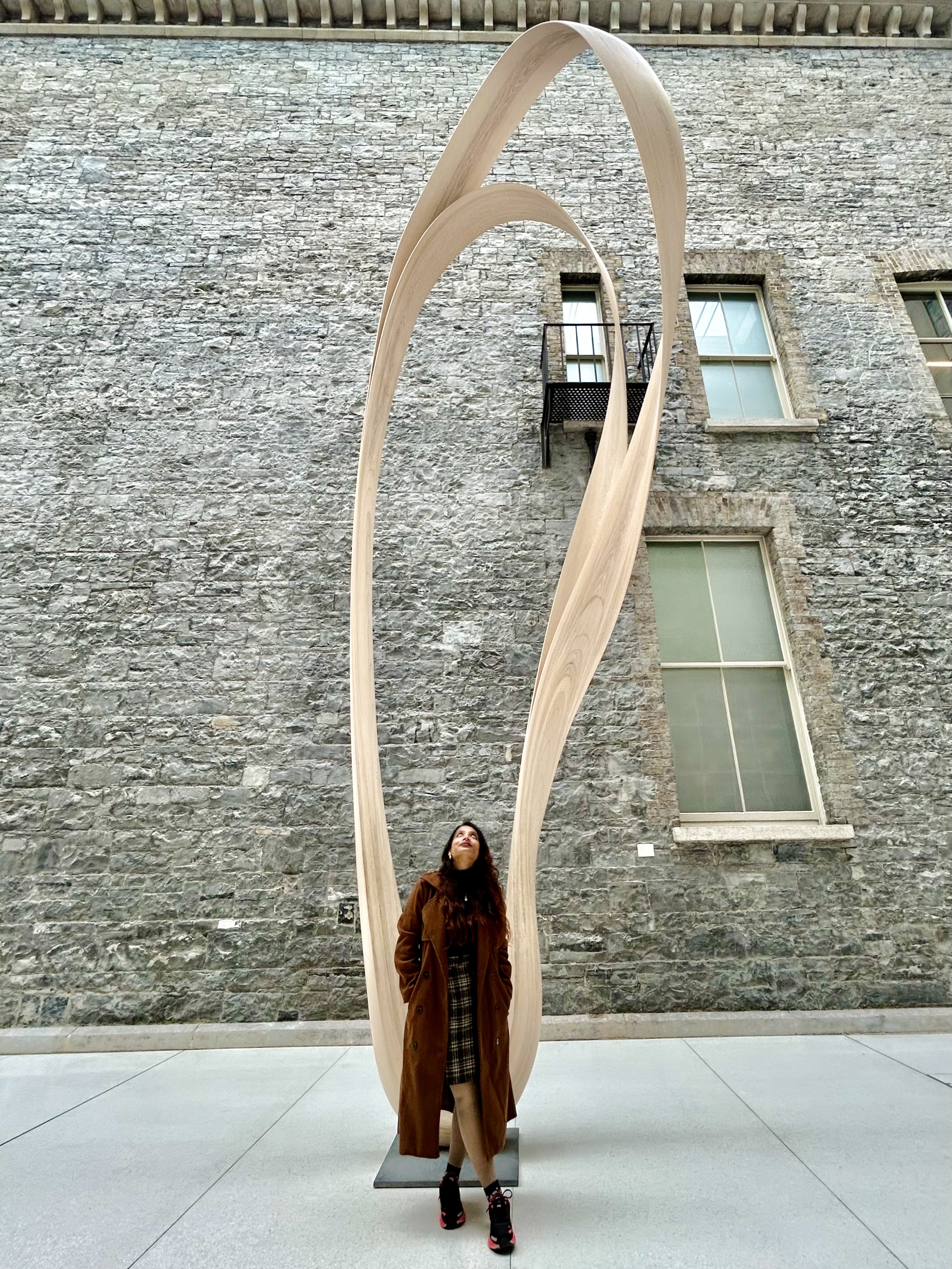
Amrita Bakshi at the National Gallery of Ireland
Research

Poetry, poetics, and the
music of modernism

Dissertation Project

"Impact and Exactitude": Musical Intentions in Marianne Moore's Poetics

My dissertation argues that Marianne Moore's poetry is not only "logopoeic" — Ezra Pound's term for verse of intellectual precision and wit — but also richly "melopoeic": alert to sound, rhythm, and auditory texture. Against a critical tradition (Stapleton, Costello, Leavell) that reads Moore as an essentially visual, spatial poet, I recover the musicality of her syllabic verse, where meaning is bound as much to sound as to sense.

Reading Moore alongside modernist music and the philosophy of music — Kant and Hegel, Schopenhauer and Nietzsche; Schoenberg, Stravinsky, Cage, and Ives; and theories of sound perception in Scruton, Hamilton, and Adorno — the project traces the three dualisms that organize her musical aesthetics: natural versus artefactual sound, austere versus flamboyant music, and spatial versus temporal form.

Amrita Bakshi in Marianne Moore's recreated writing room beside the blue typewriter Moore wrote on
In Marianne Moore's recreated writing room, beside the blue typewriter she wrote on — The Rosenbach, Philadelphia
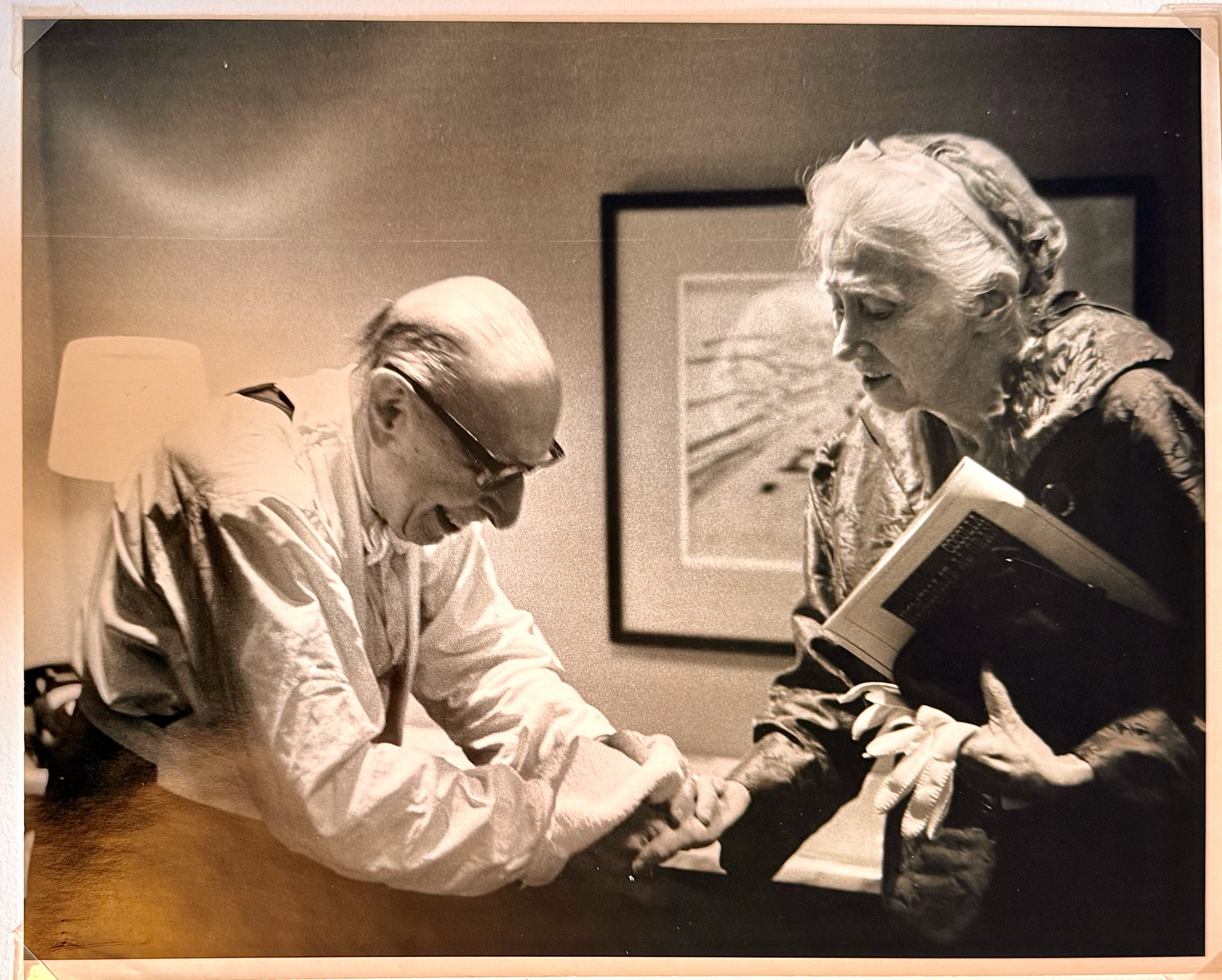
Igor Stravinsky bowing over Marianne Moore's hands
Archival Photograph · Key Figure

Igor Stravinsky and Marianne Moore

In a gesture of deep mutual respect, Stravinsky bows over Moore’s hands — an encounter between two of the twentieth century’s most exacting modernist minds. Stravinsky’s theoretical writings, and in particular his distinction between mere cacophony and a “musical complex” that is legitimate precisely because it is genuine, form a central pillar of this dissertation’s argument about Moore’s poetics of dissonance, propriety, and measured musicality.

Photographer unknown. Courtesy of the Rosenbach Museum & Library, Philadelphia. Rosenbach Museum & Library Archives, Philadelphia, Pennsylvania.
Dissertation Chapters
Chapter I
Music: The Art of the Beautiful Play of Sensations
{{ c1i }}

Establishes the philosophical and aesthetic framework for music's contested place among the arts — from Kant's and Hegel's distrust of music as the mere "beautiful play of sensations" to Schopenhauer's and Nietzsche's claims for it as the deepest art. It introduces the three dualisms that structure the dissertation: natural versus artefactual sound, austere versus flamboyant music, and spatial versus temporal form.

Chapter II
Moore's Orchestra: Acoustic Metaphors and Authentic Sounds
{{ c2i }}

Where Chapter I asked where music ranks among the arts, this chapter narrows to how an organized sound comes to mean, taking up the first dualism — natural versus artefactual sound — to show how noises with plain causes, a frog, a storm, a bird, can be heard both as shaped, rhythmic events and as what they are. Drawing on Hanslick's formalism, Scruton's acoustic intentionality, Hamilton's acousmatic double intentionality, Schaeffer's objet sonore, and Adorno's socio-historical critique, the chapter reads "The Plumet Basilisk," "The Steeple-Jack," and "Bird-Witted" to show a made sound earning its place by declaring its making rather than counterfeiting nature.

Chapter III
Moore's Dissonance: A Study in Propriety
{{ c3i }}

Building on Chapter II's finding that Moore's harshest sounds fall where a creature, a town, or a stretch of land lies open to harm, this chapter asks why she rations dissonance so strictly. Its answer is propriety — Moore's own term for a "tuned reticence with rigor," the mark of an austere rather than flamboyant conception of musical sound. Drawing on Schoenberg's "emancipation of the dissonance," Stravinsky's line between genuine harshness and mere cacophony, and Adorno's claim that dissonance is more rational than consonance, the chapter reads "Propriety," "Those Various Scalpels," and "Marriage" to show how Moore's rationed dissonances register real danger without inflating it.

Chapter IV
Moore's Precision: Music in the Abstract Image
{{ c4i }}

Turns to the third dualism — spatial versus temporal — challenging the consensus that Moore's poetics are purely painterly. Through "The Jerboa," "Propriety," and others, and alongside Cubism, Hugh Kenner, Fiona Green, and James Longenbach, it argues that rhyme, meter, and rhythmic variation give her syllabic verse a temporal, musical dynamism in which "precision is both impact and exactitude."

Areas of Specialization
Modernist Poetics & the Ear
Moore's syllabic verse as melopoeia — read alongside, not against, Pound's logopoeia. Enjambment, percussive diction, and the poem's aural life as they bind sound to sense.
The Avant-Garde & Music
Poetry's traffic with modernist music — musique concrète, Schoenberg's emancipation of the dissonance, Stravinsky's rhythm, and Cage's silence — and theories of sound perception in Scruton, Hamilton, and Adorno.
Victorian Temporalities
Time, utility, and femininity in nineteenth-century writing, and its afterlives in modernist form.
Postcolonial & Global Anglophone
Counter-hegemonic reading across colonial famines, comparative literatures, and world Anglophone traditions.
Posthumanism
The "beyond-human" and "becoming-human" — ustopian paradox and the limits of the human in contemporary fiction.
Comparative Literature
Reading across Yeats and Bankim Chandra, Dostoevsky and Conrad — doubles, doublings, and shared histories.
Recent Research Highlights
Full list →
2026
"When 'Beyond-Human' is 'Becoming-Human': An Ustopian Paradox in Margaret Atwood's Oryx and Crake" — Interconnections: Journal of Posthumanism (peer-reviewed article)
Oct 2025
"A Soft Uninvented Music: Marianne Moore's Orchestra of Acoustic Metaphors and Authentic Sounds" — Marianne Moore Generations Conference, Stanford Humanities Center
Apr 2025
"Comparing the Colonial Famines: Counter-Hegemonic Failures in W. B. Yeats' The Countess Cathleen and Bankim Chandra's Ananda Math" — 8th Annual South Asia Conference, Dublin City University
Archival Work

The Marianne Moore Archives — The Rosenbach, Philadelphia

In April 2026 I travelled to the Rosenbach Museum and Library in Philadelphia to conduct archival research for the dissertation. There, in the recreated rooms of Moore's Greenwich Village living room and among her papers, I studied her poems and drafts, her newspaper clippings, and her personal library — tracing everything she knew and read on the aesthetics and philosophy of music.

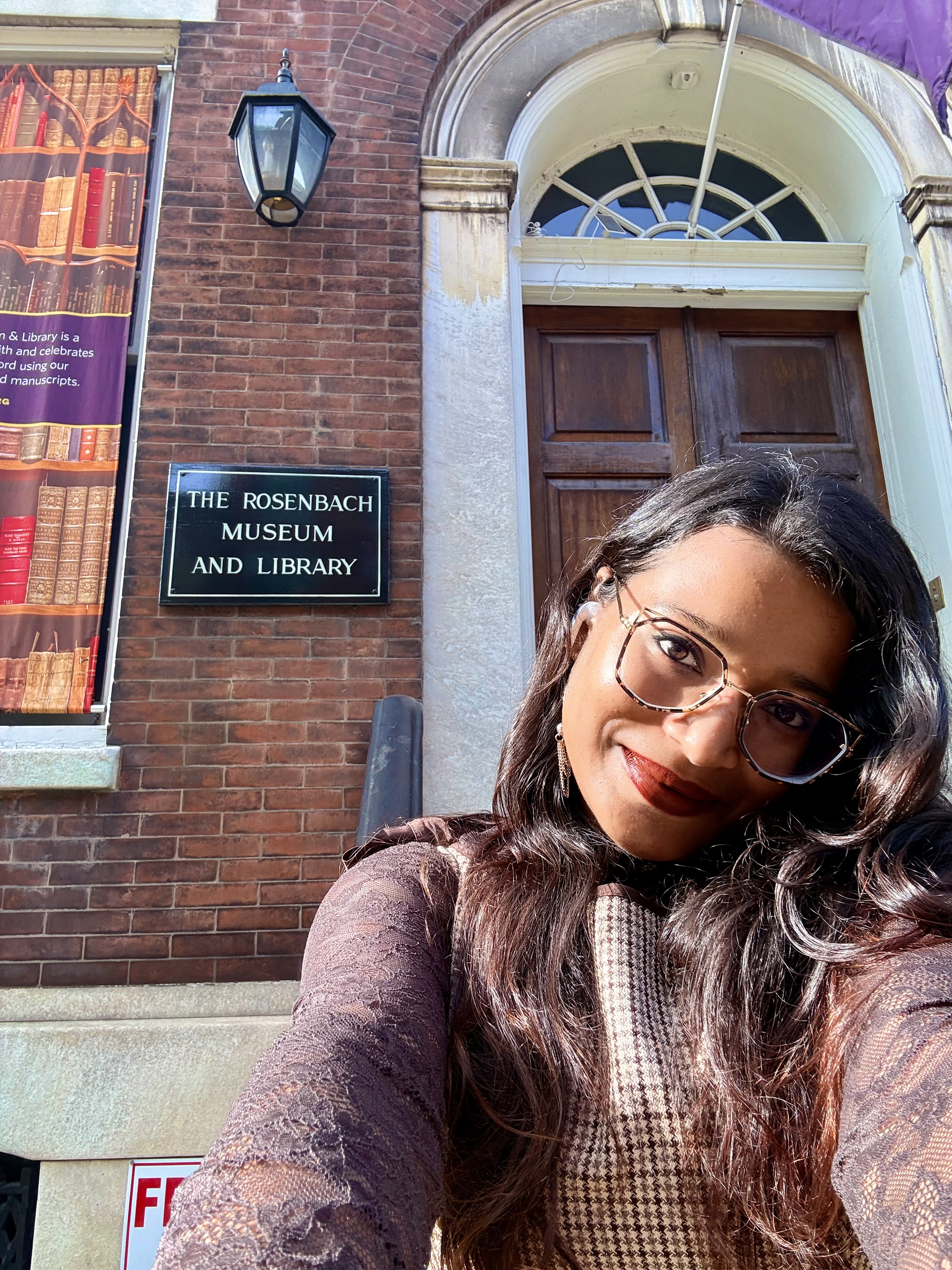
Amrita Bakshi at the Rosenbach Museum and Library, Philadelphia
The Rosenbach Museum & Library · April 2026
What I consulted
Manuscript poems and working drafts in Moore's hand
Her newspaper clippings and reading notes
Moore's personal library — the volumes she owned and annotated
Materials tracing her knowledge of music aesthetics and philosophy
Archival Finds
Manuscripts & Typescripts
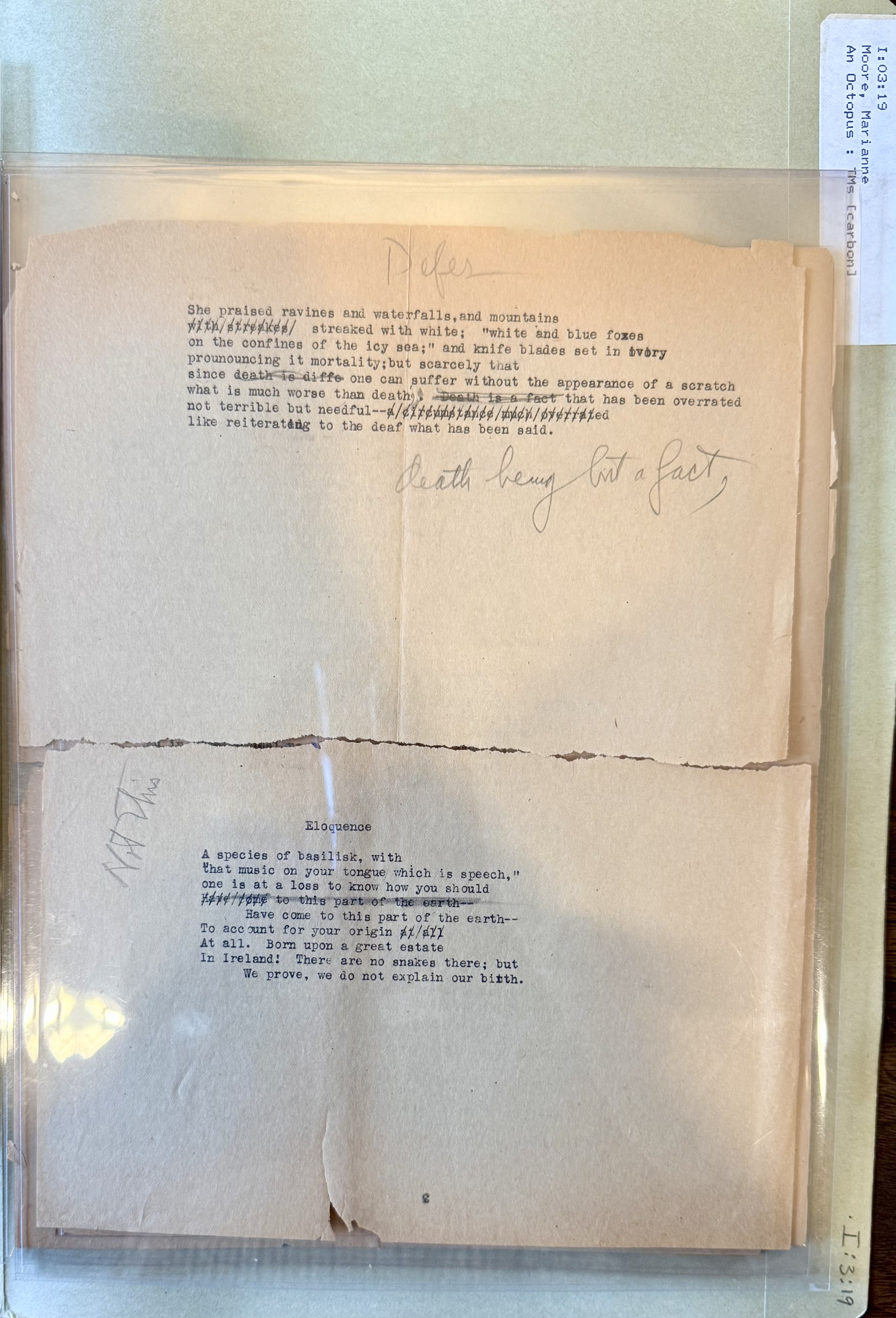
An unfinished, unpublished two-stanza fragment found among the typed drafts of An Octopus
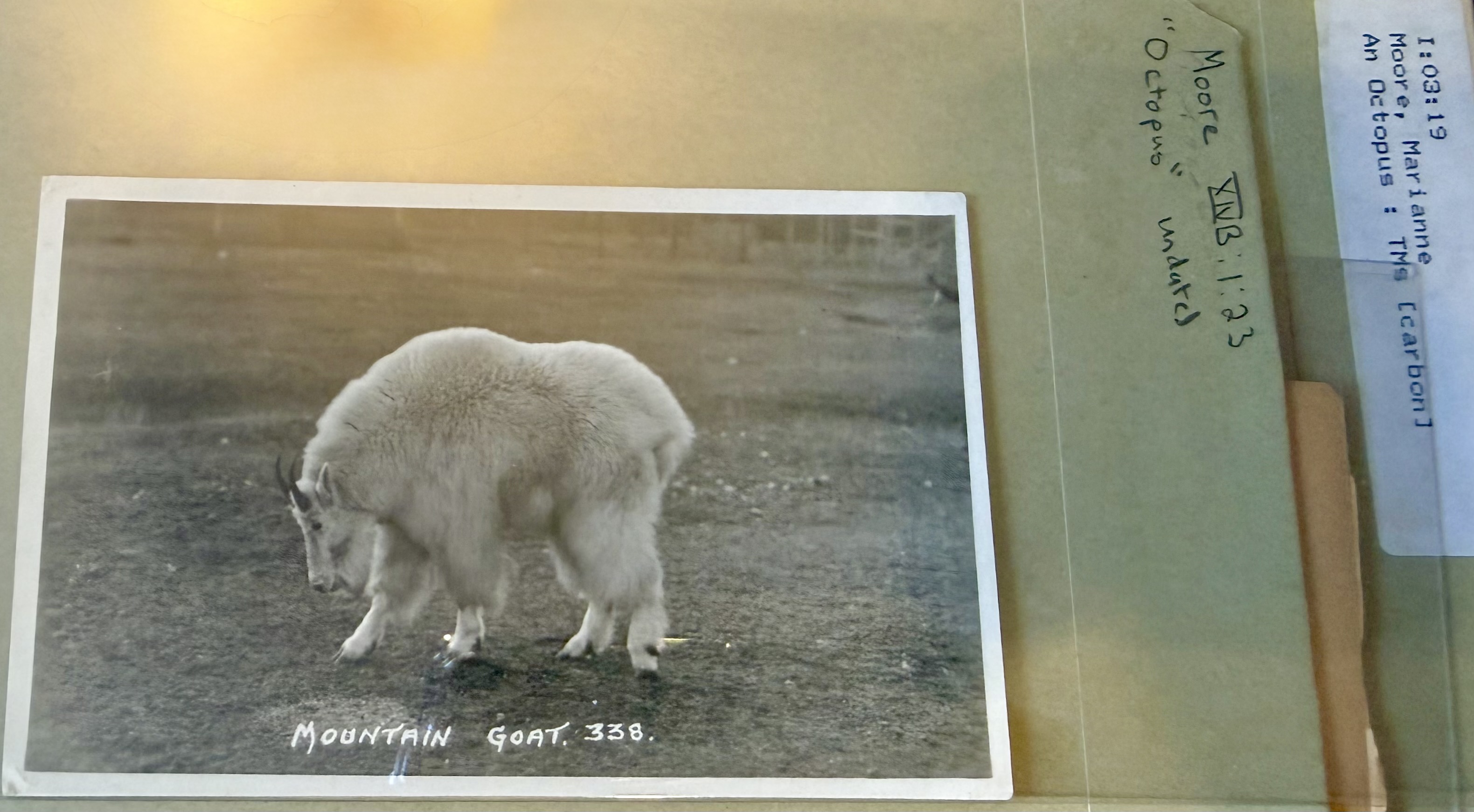
A photo of a mountain goat Moore saw and preserved, the animal featured in An Octopus
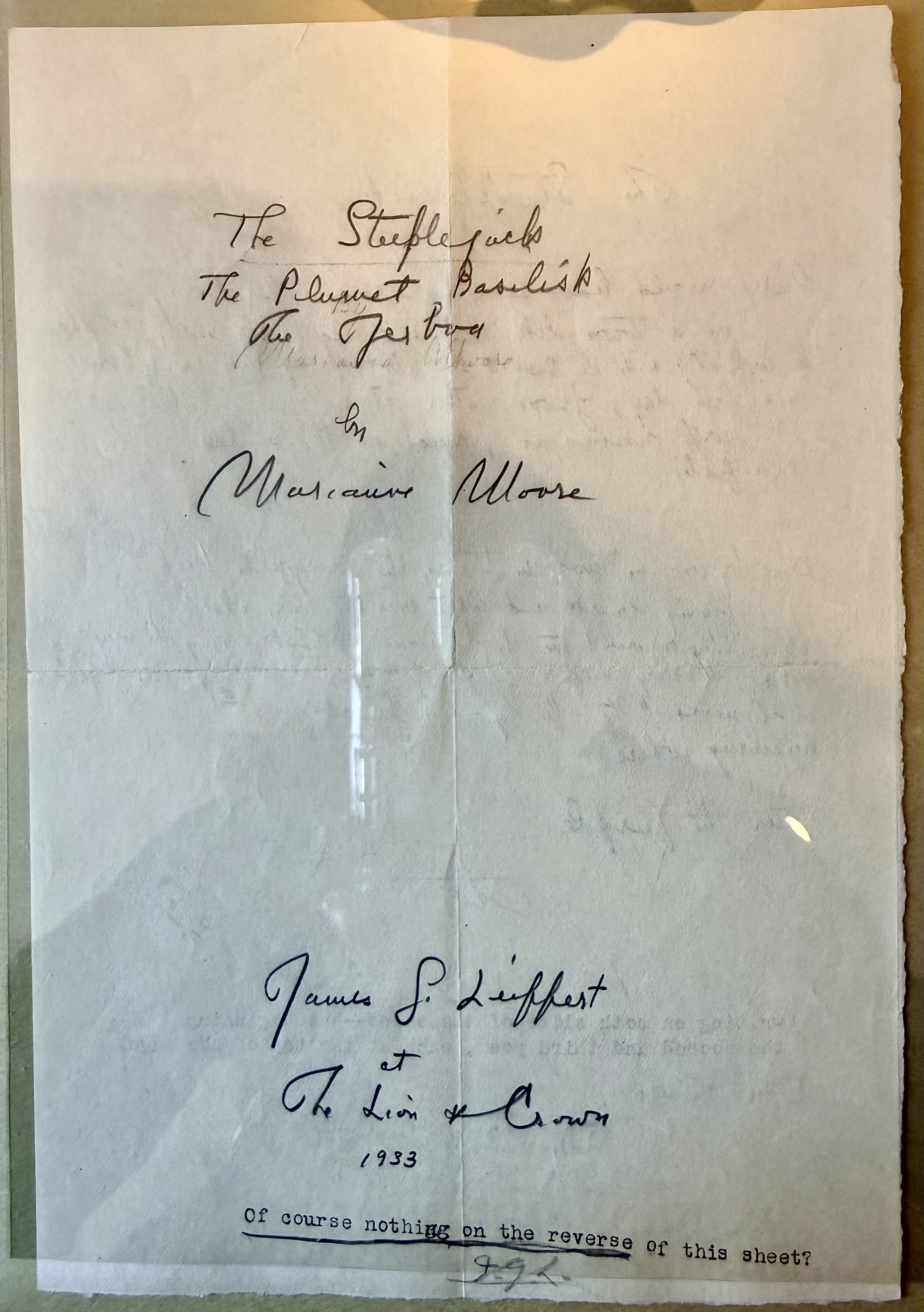
Moore grouped The Steeple-Jack, The Plumet Basilisk, and The Jerboa as a trio to submit to Hound and Horn in 1933
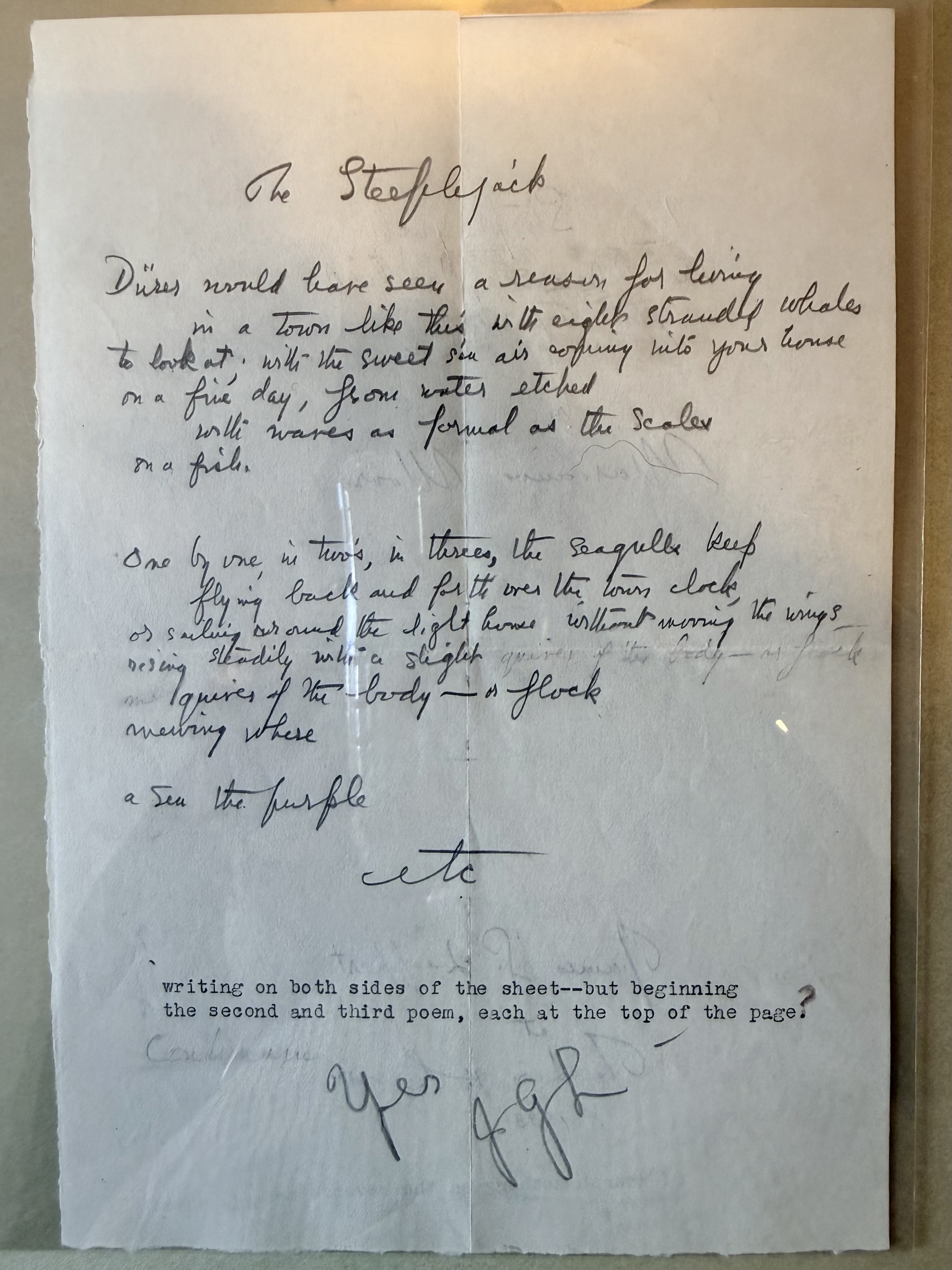
Moore's submission of The Steeple-Jack to Hound and Horn
See her manuscripts, in full ↓
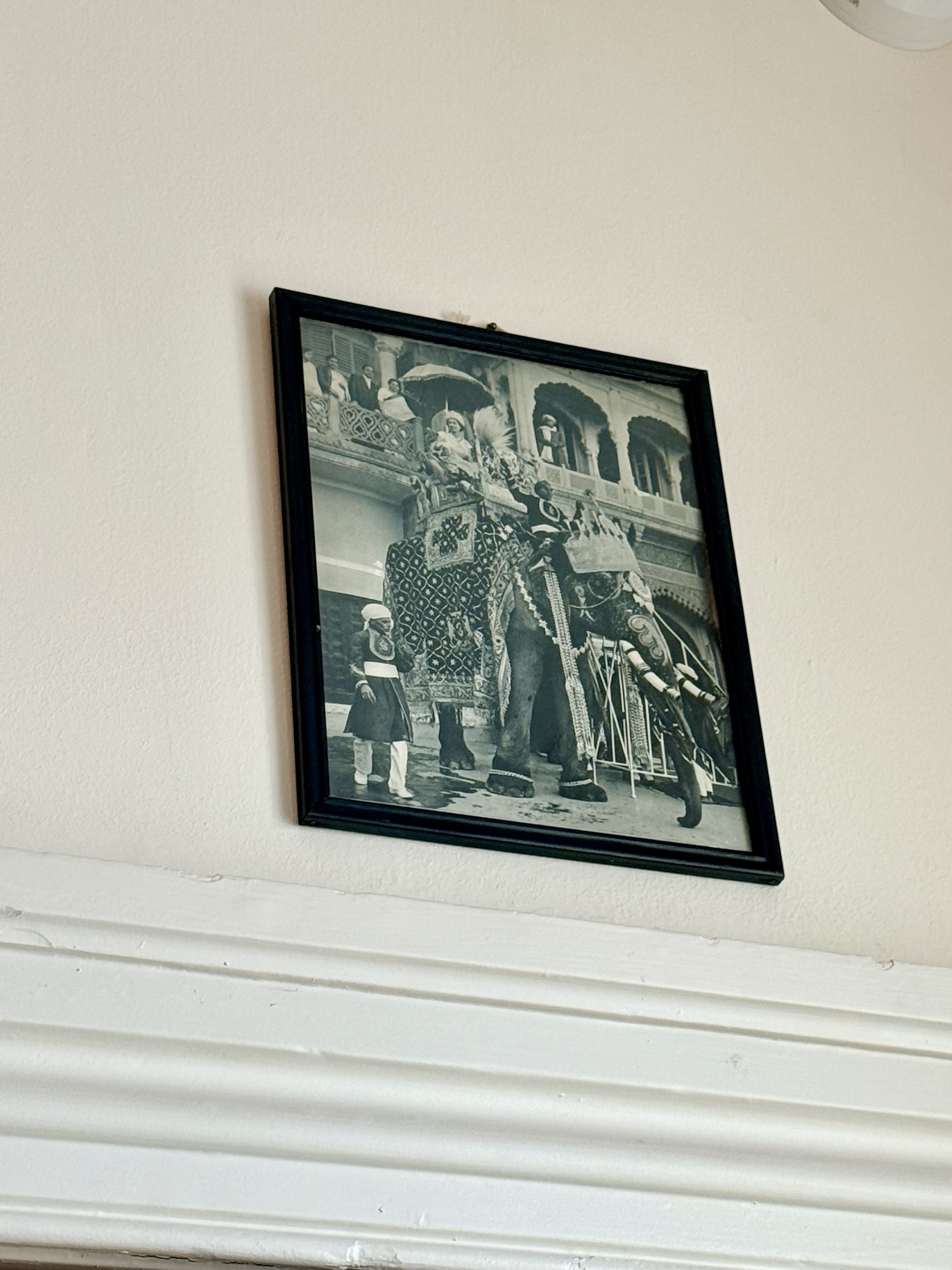
A framed print of an Indian elephant from Marianne Moore's collection
A print of an Indian elephant — a creature Moore was forever fascinated with
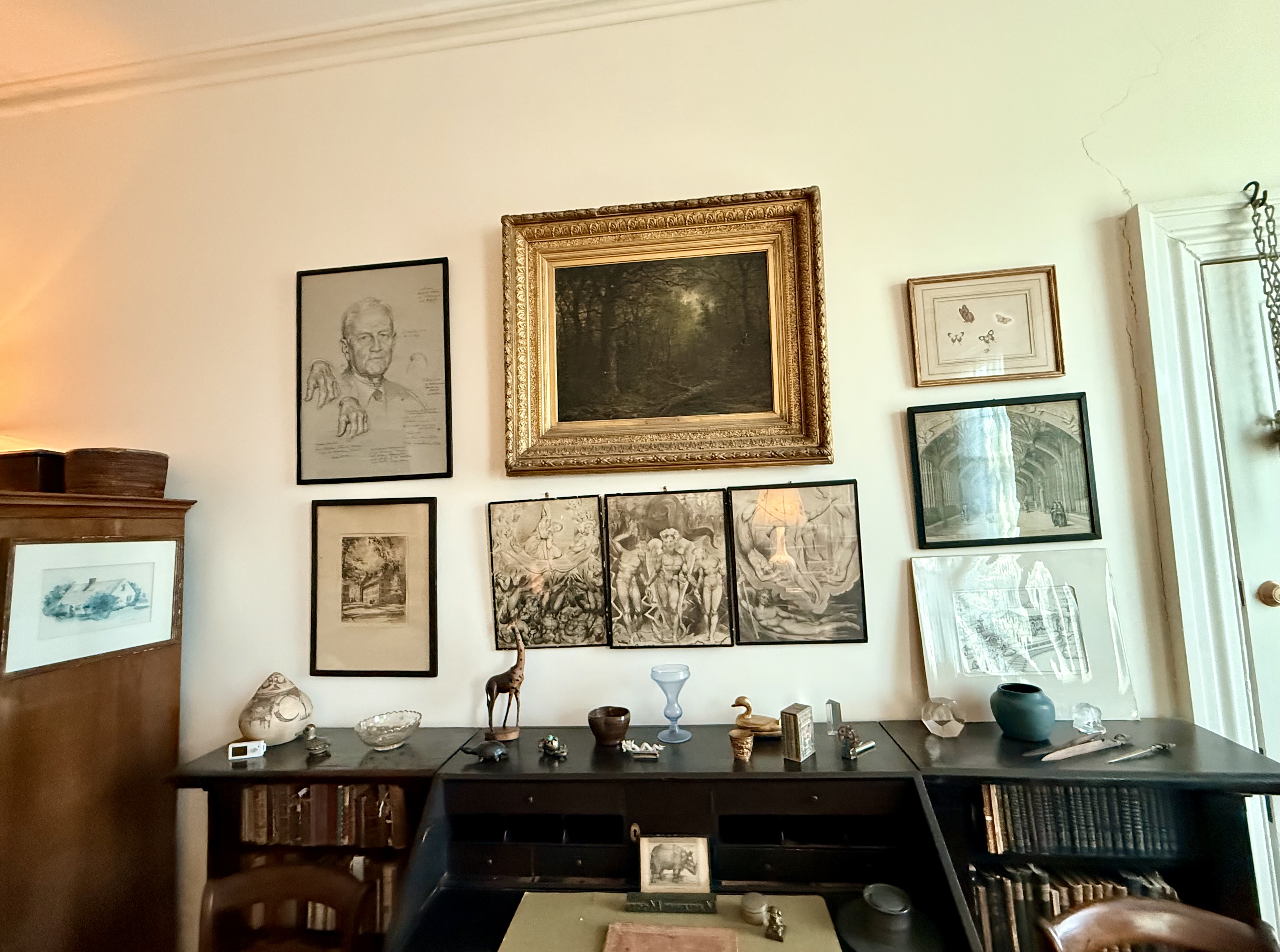
Moore's writing desk and gallery wall
Her writing desk & pictures
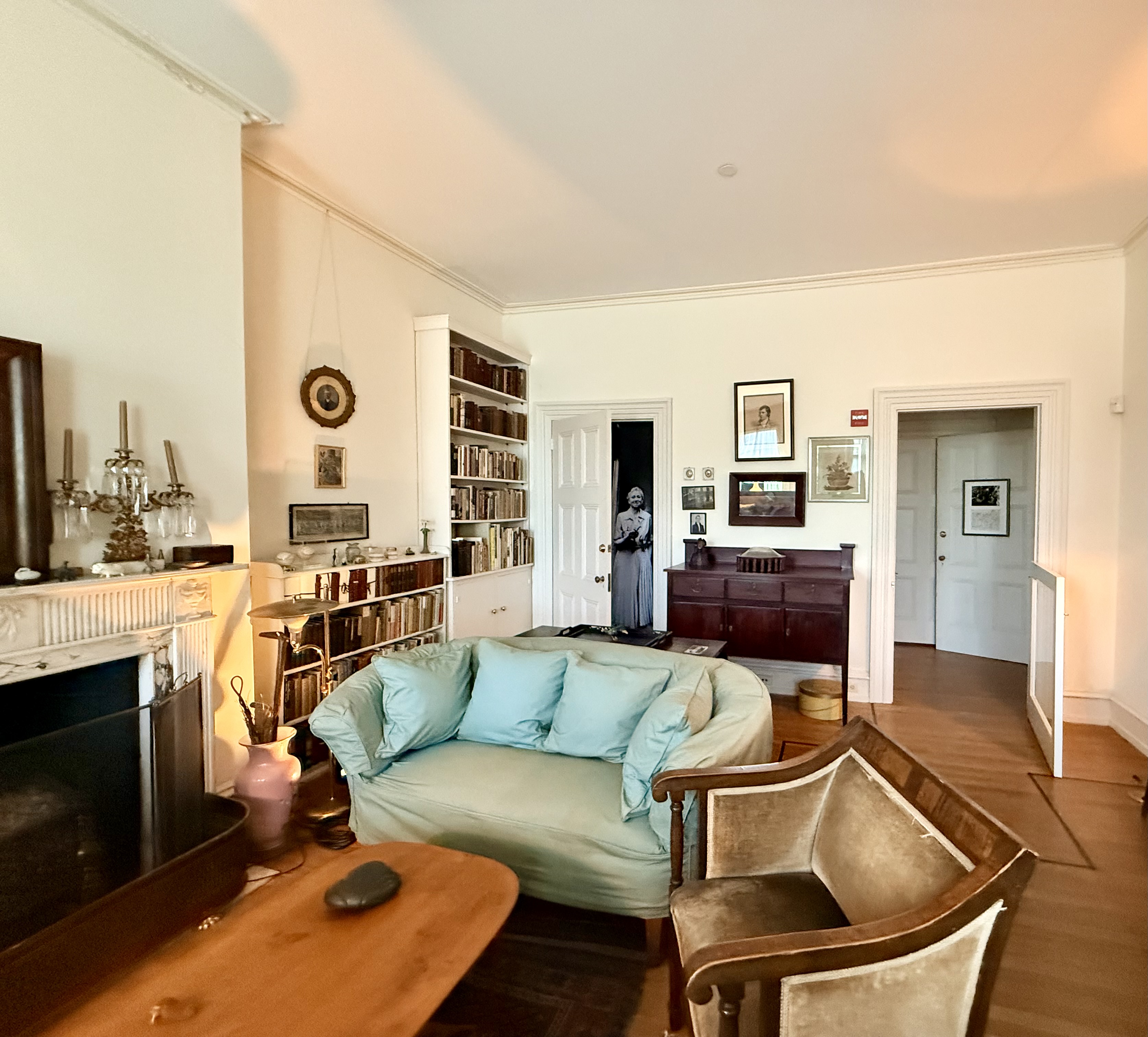
Moore's recreated living room
The living room, recreated
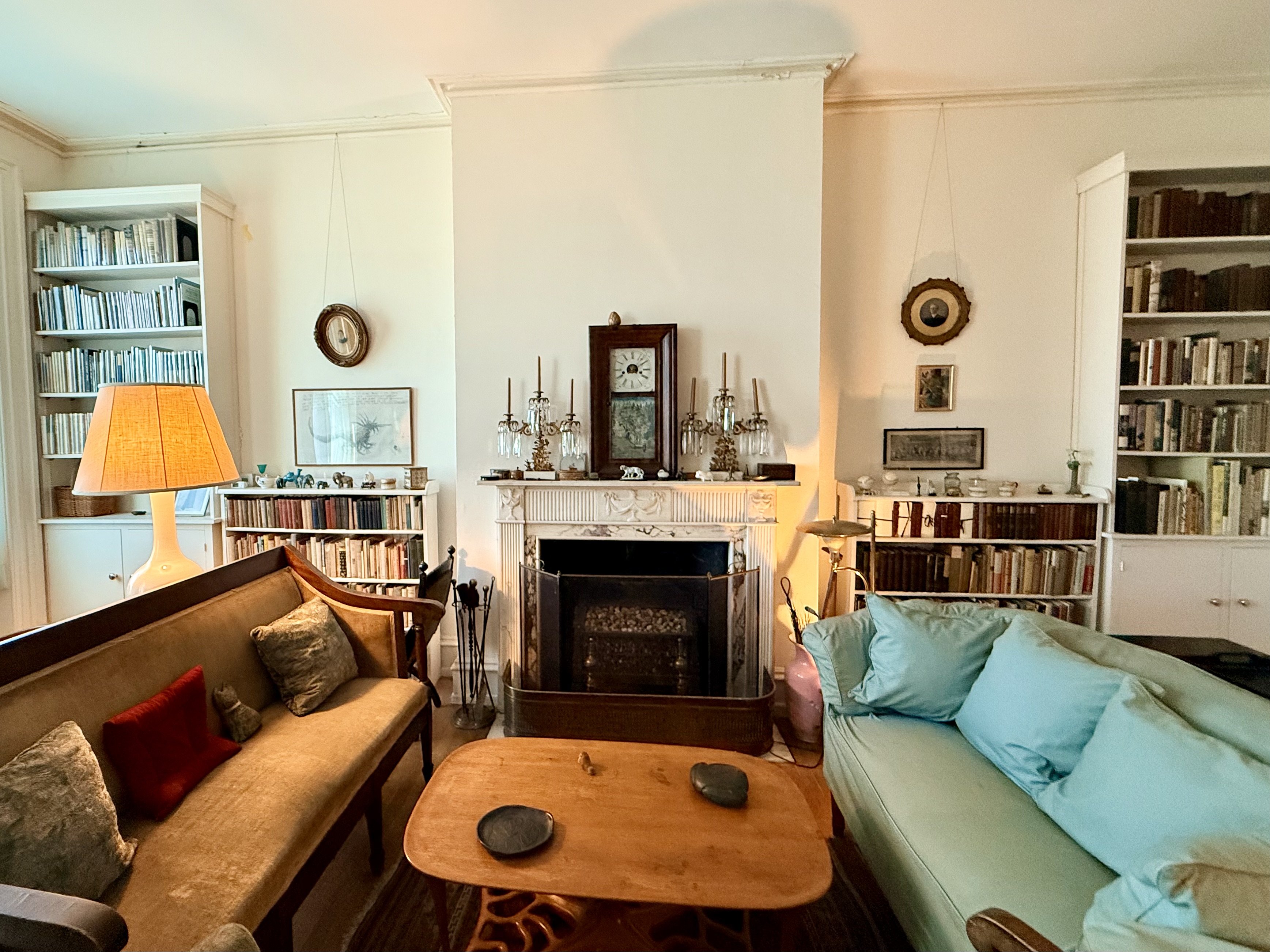
Fireplace and bookshelves in Moore's rooms
Fireplace & her library
Album 01 · From Moore's Personal Library

What Moore read on music

{{ mlLabel }}

This first album gathers the volumes Moore owned and annotated — tracing exactly what she knew and was aware of on music, musical thought, and the philosophy and aesthetics of sound.

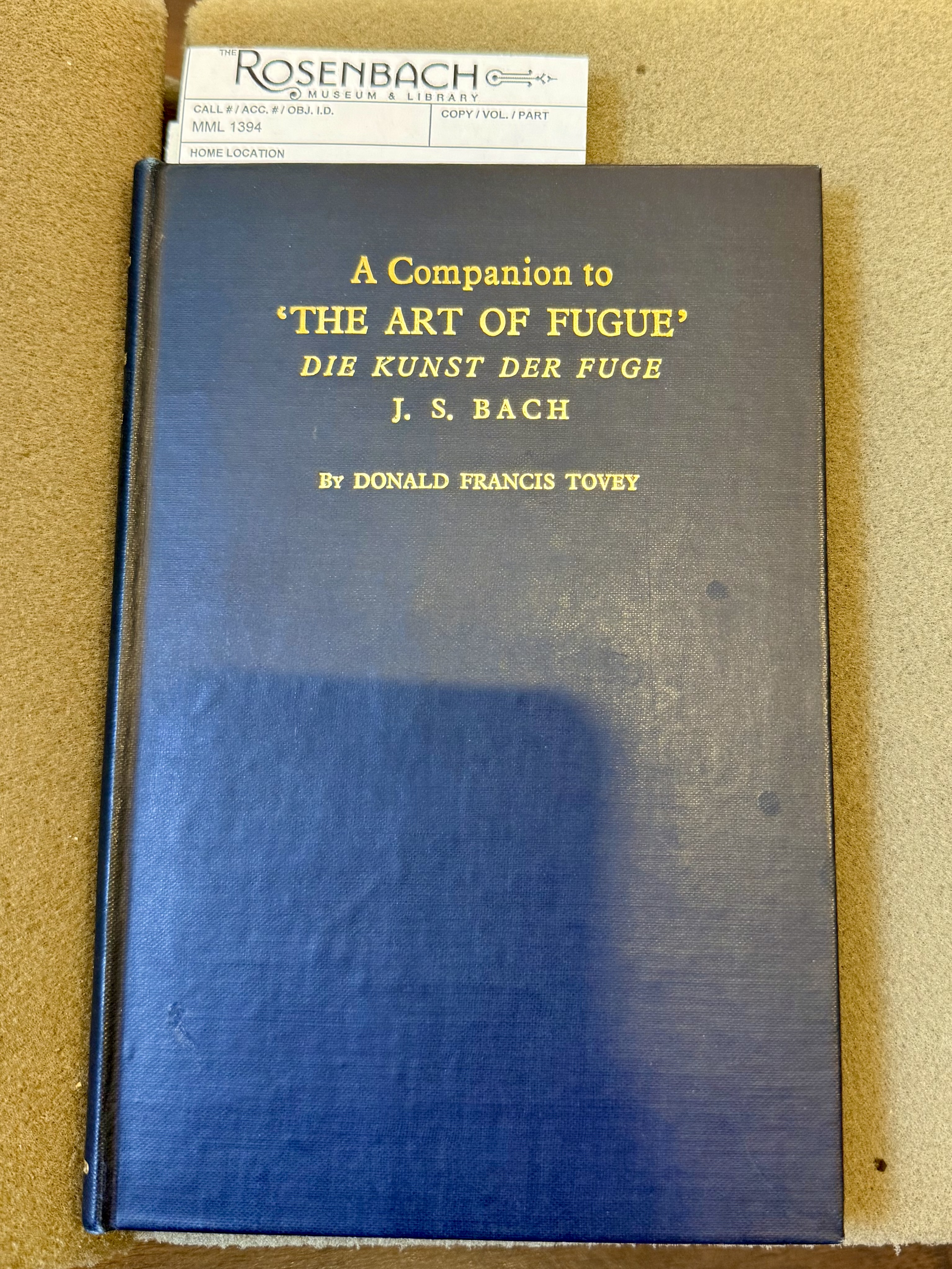
A Companion to Bach's The Art of Fugue, from Moore's library
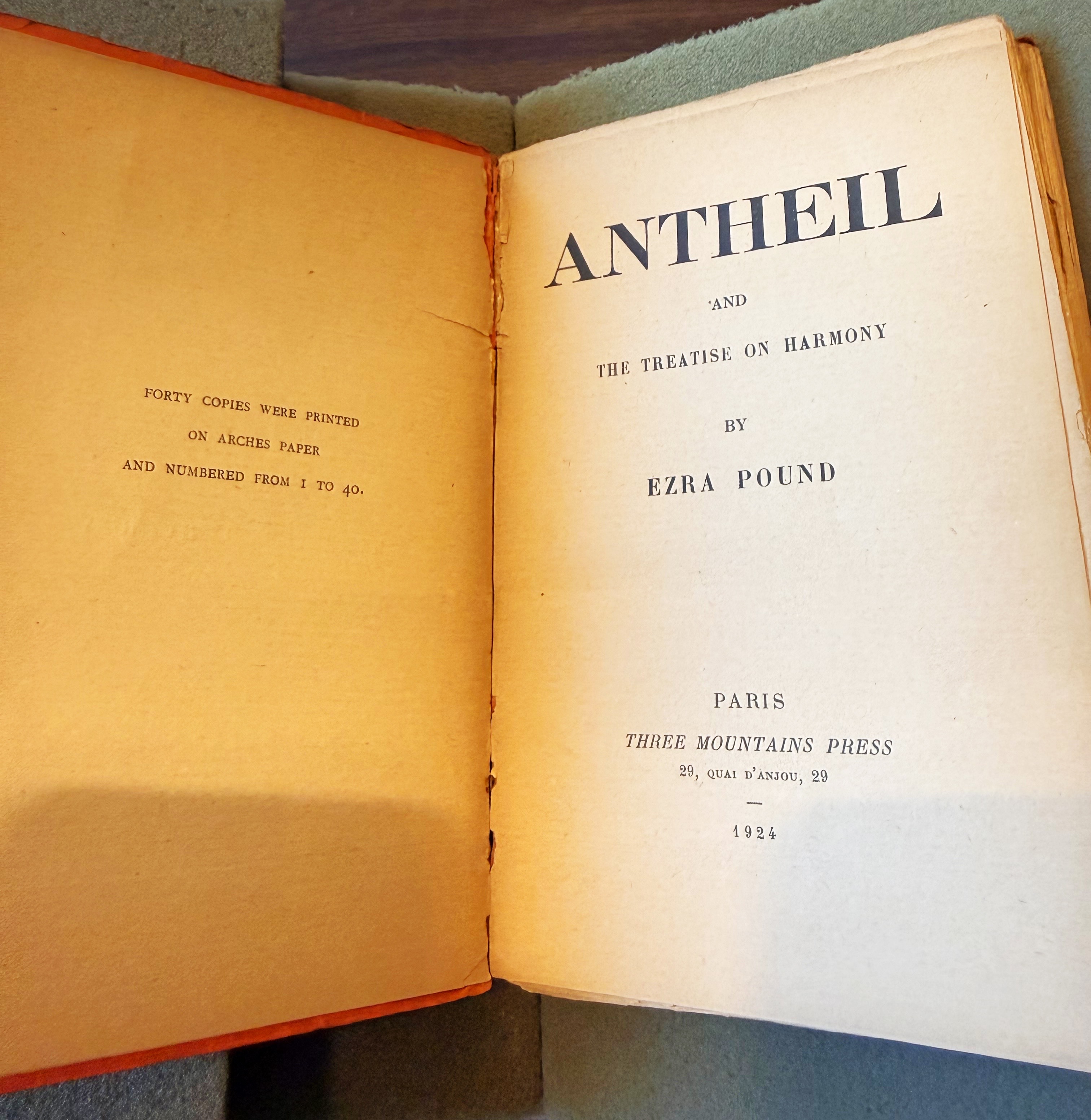
Ezra Pound's Antheil and the Treatise on Harmony, inscribed to Moore
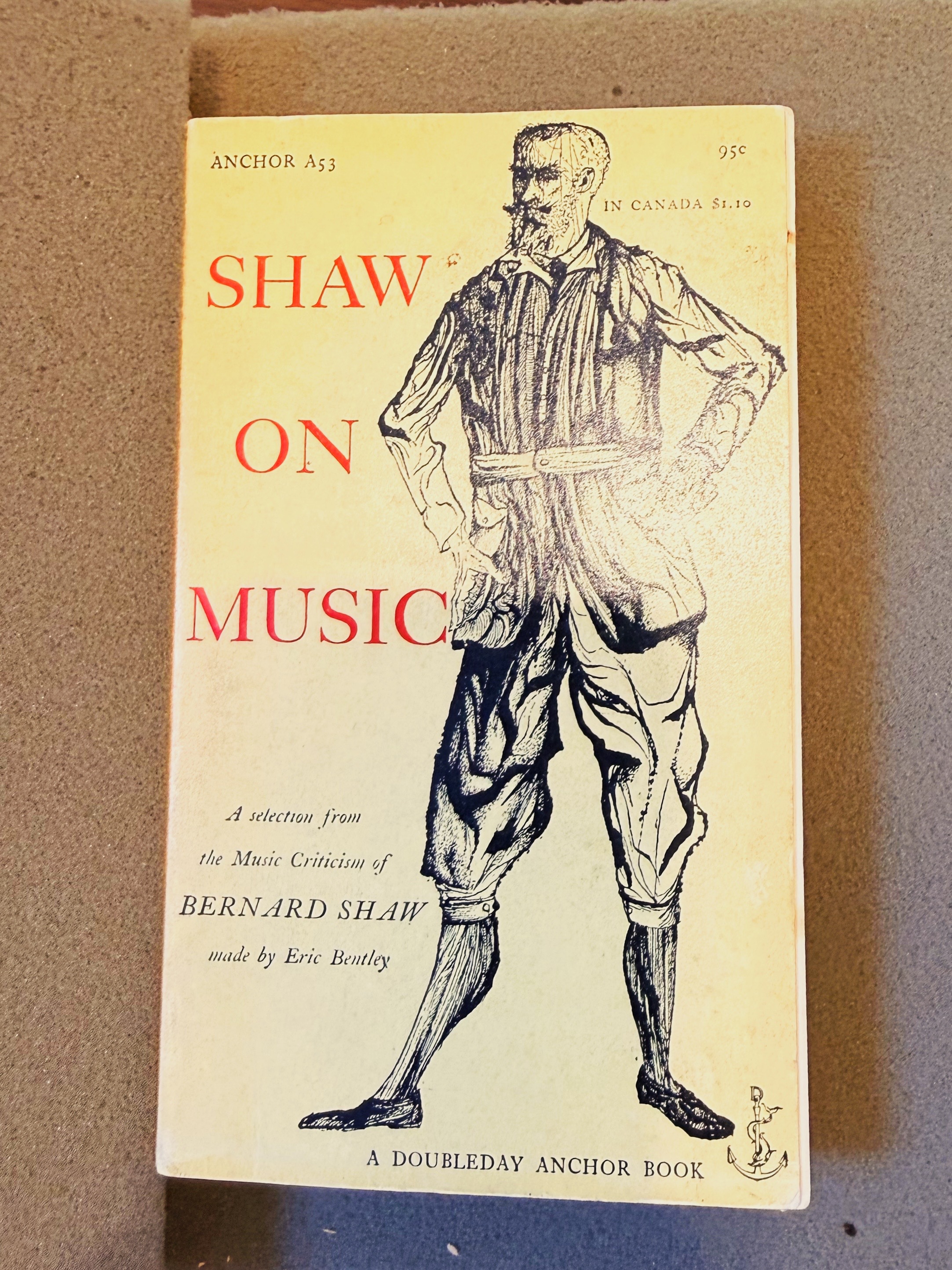
Shaw on Music, from Moore's library
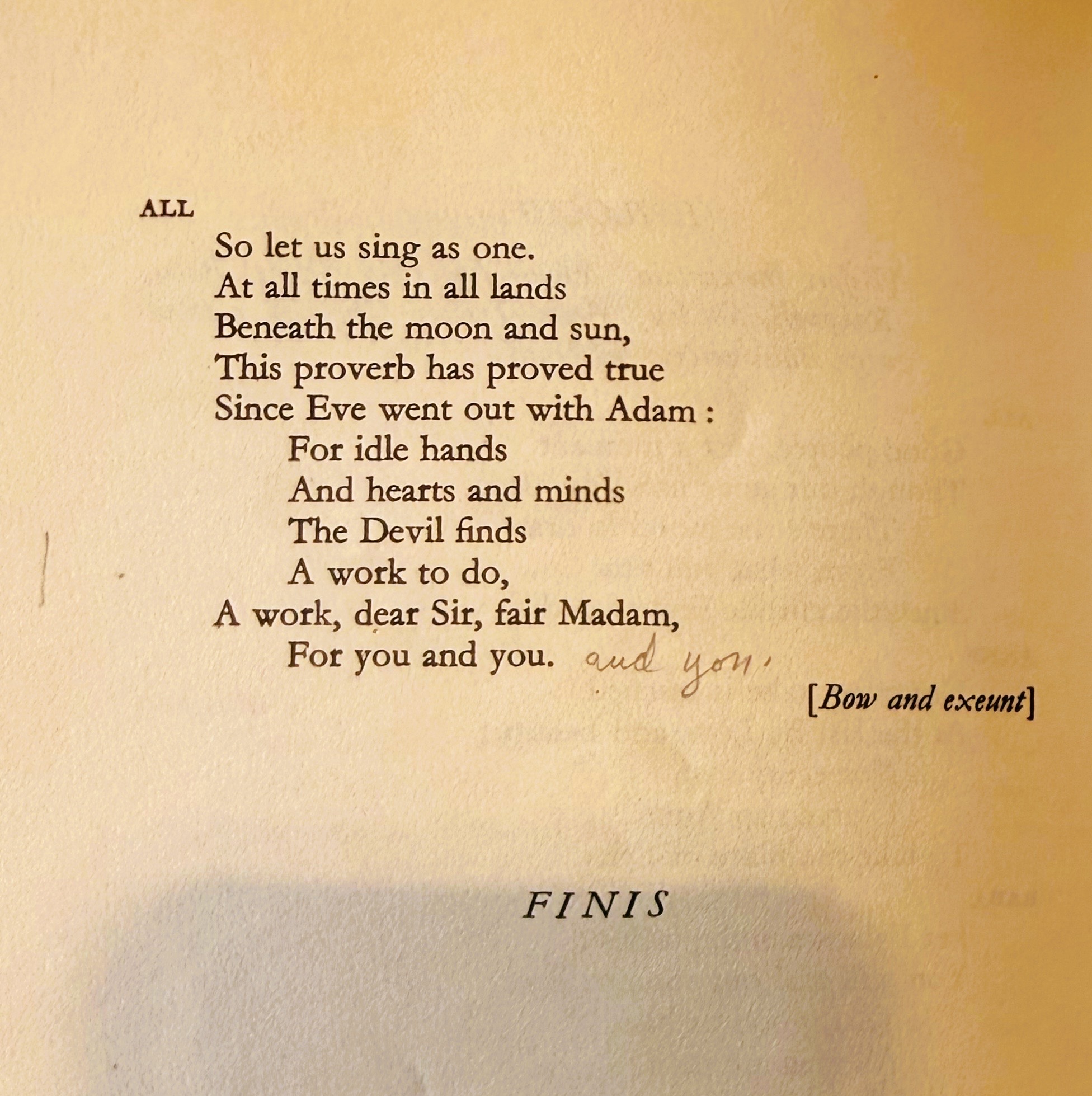
Moore's Metropolitan Opera libretto for Stravinsky's The Rake's Progress
All volumes shown are held by the Rosenbach Museum & Library, Philadelphia, and are reproduced courtesy of the Rosenbach for scholarly, non-commercial use.
More scans & documents from her library coming soon.
A Companion to Bach's The Art of Fugue, by Donald Francis Tovey, from Moore's library
01A Companion to "The Art of Fugue" — Donald Francis Tovey's analytical study of Bach, examining the compositional logic and architecture of the fugue.
Ezra Pound's Antheil and the Treatise on Harmony, this copy a gift to Moore from Pound
02Antheil and the Treatise on Harmony — Ezra Pound's 1924 study of the composer George Antheil; Moore's copy was a gift from Pound himself.
Shaw on Music, from Moore's library
03Shaw on Music — Bernard Shaw's collected music criticism, through which Moore encountered the era's central debate: whether music existed to construct "beautiful sound patterns" or to "express emotion."
Moore's Metropolitan Opera libretto for Stravinsky's The Rake's Progress, ending with her handwritten aside
04The Rake's Progress — Moore's Metropolitan Opera libretto for Stravinsky's opera, annotated at the closing line with her own interjection: "and you."
Album 02 · From the Archives

Poems: manuscripts & typescripts

{{ msLabel }}

This second album gathers drafts, submissions, and the preserved clippings and photographs behind some of Moore's best-known poems — all consulted in the Marianne Moore Collection at the Rosenbach Museum & Library, Philadelphia.

An unfinished, unpublished two-stanza fragment from the drafts of An Octopus
A mountain goat Moore saw and preserved, featured in An Octopus
Moore grouped three poems as a trio for Hound and Horn in 1933
Moore's submission of The Steeple-Jack to Hound and Horn
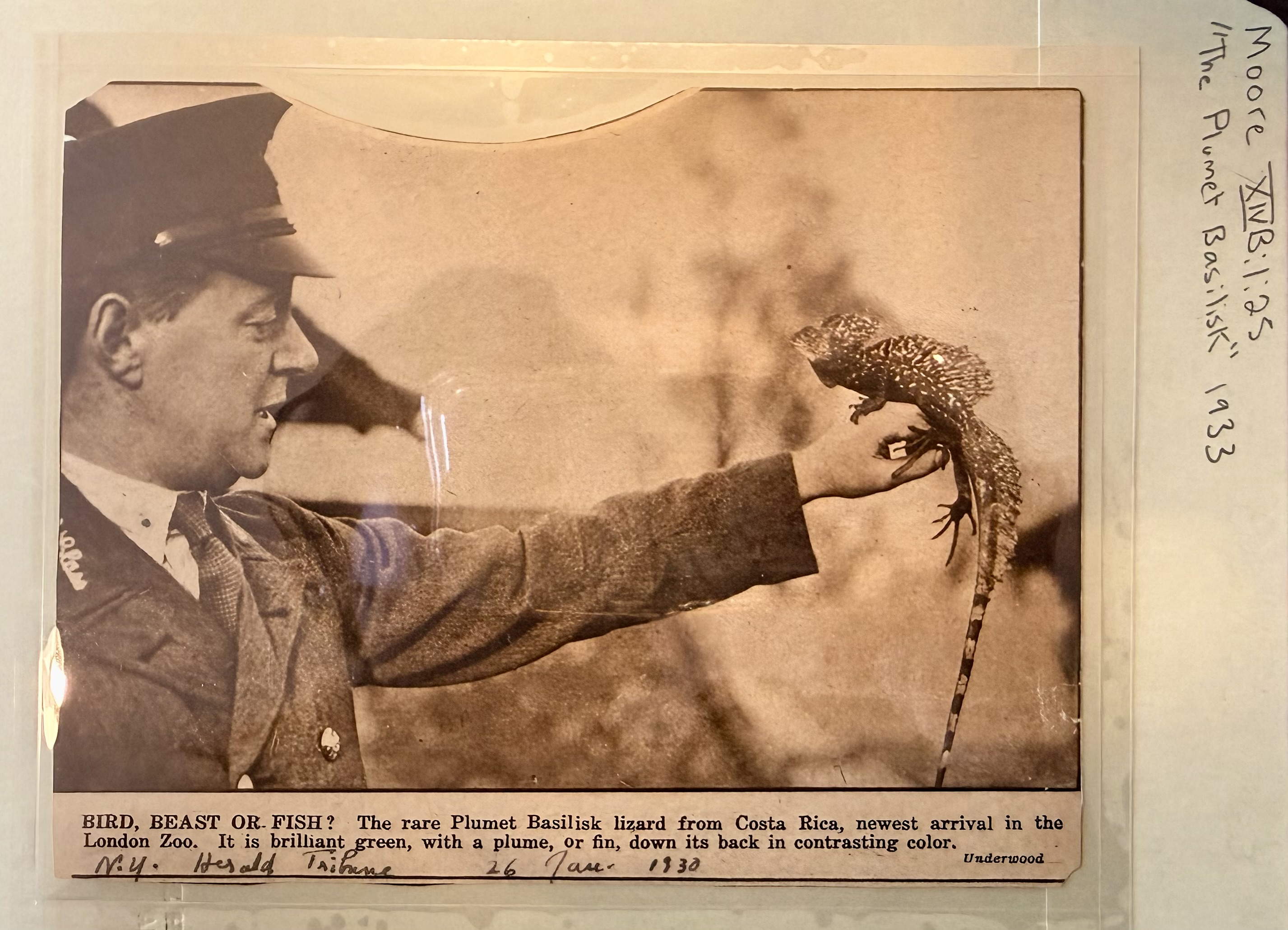
The Plumet Basilisk Moore saw in the New York Herald
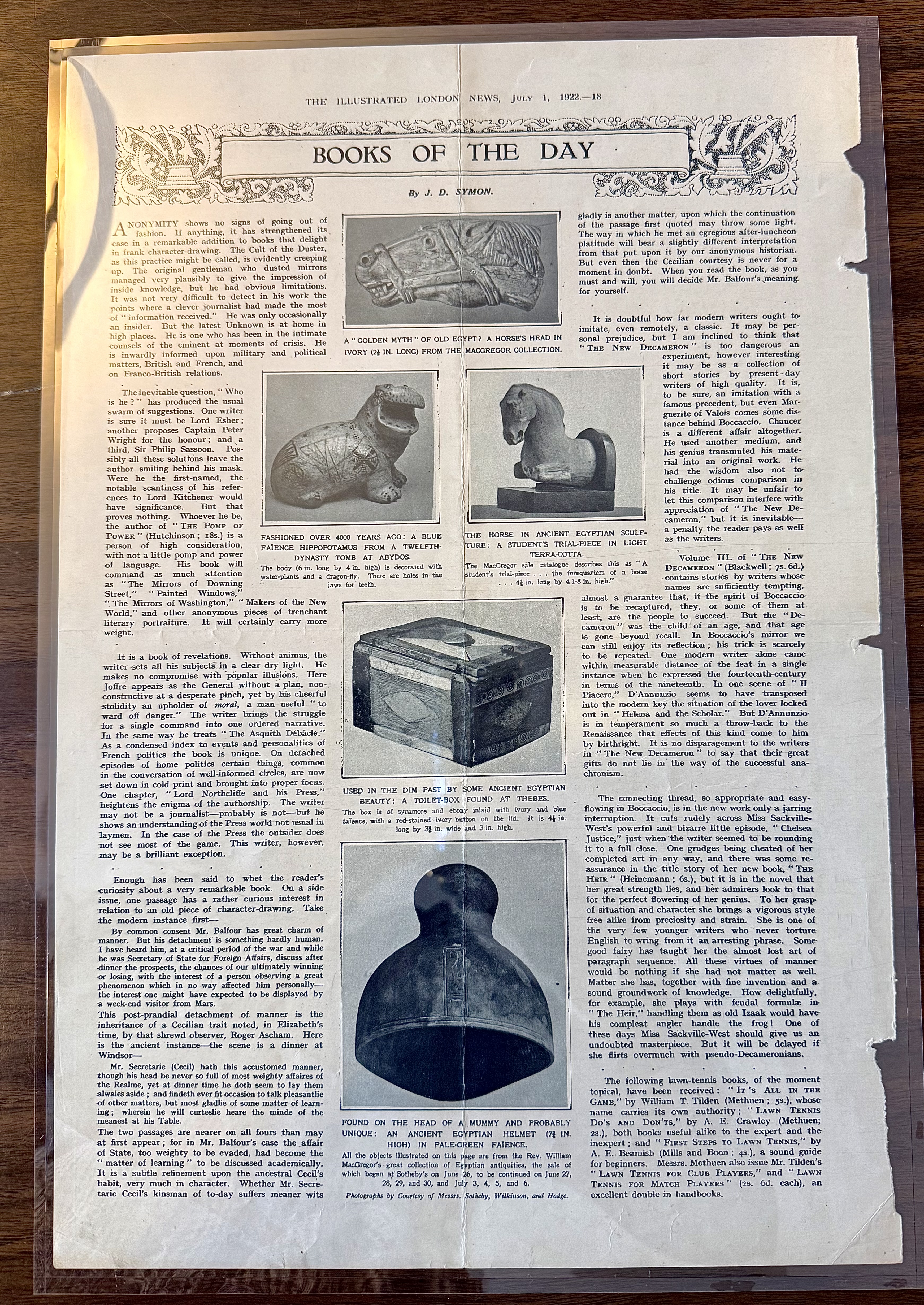
How Moore knew the Egyptian artifacts mentioned in The Jerboa
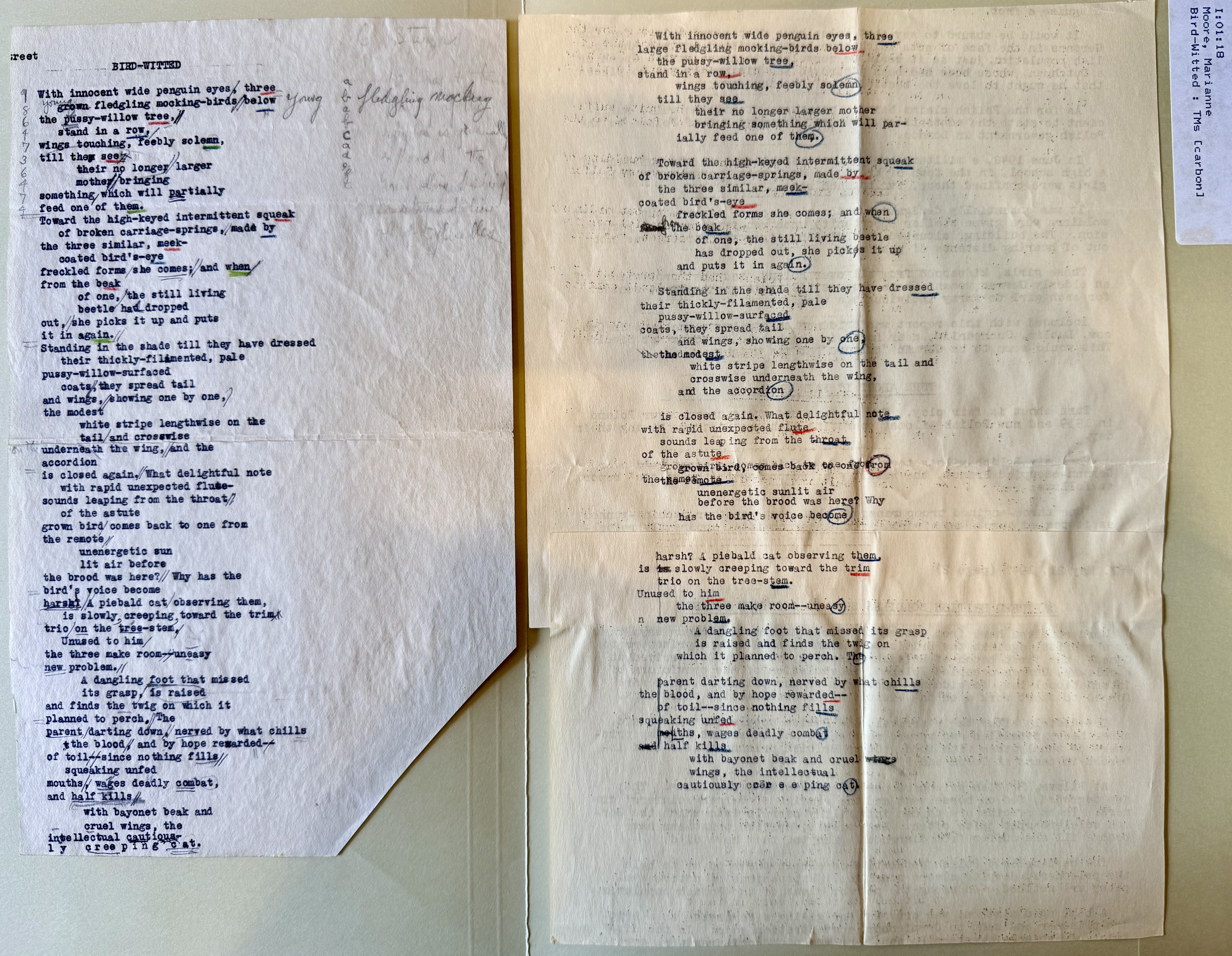
Moore's typescript of Bird-Witted, marking rhyme and rhythm
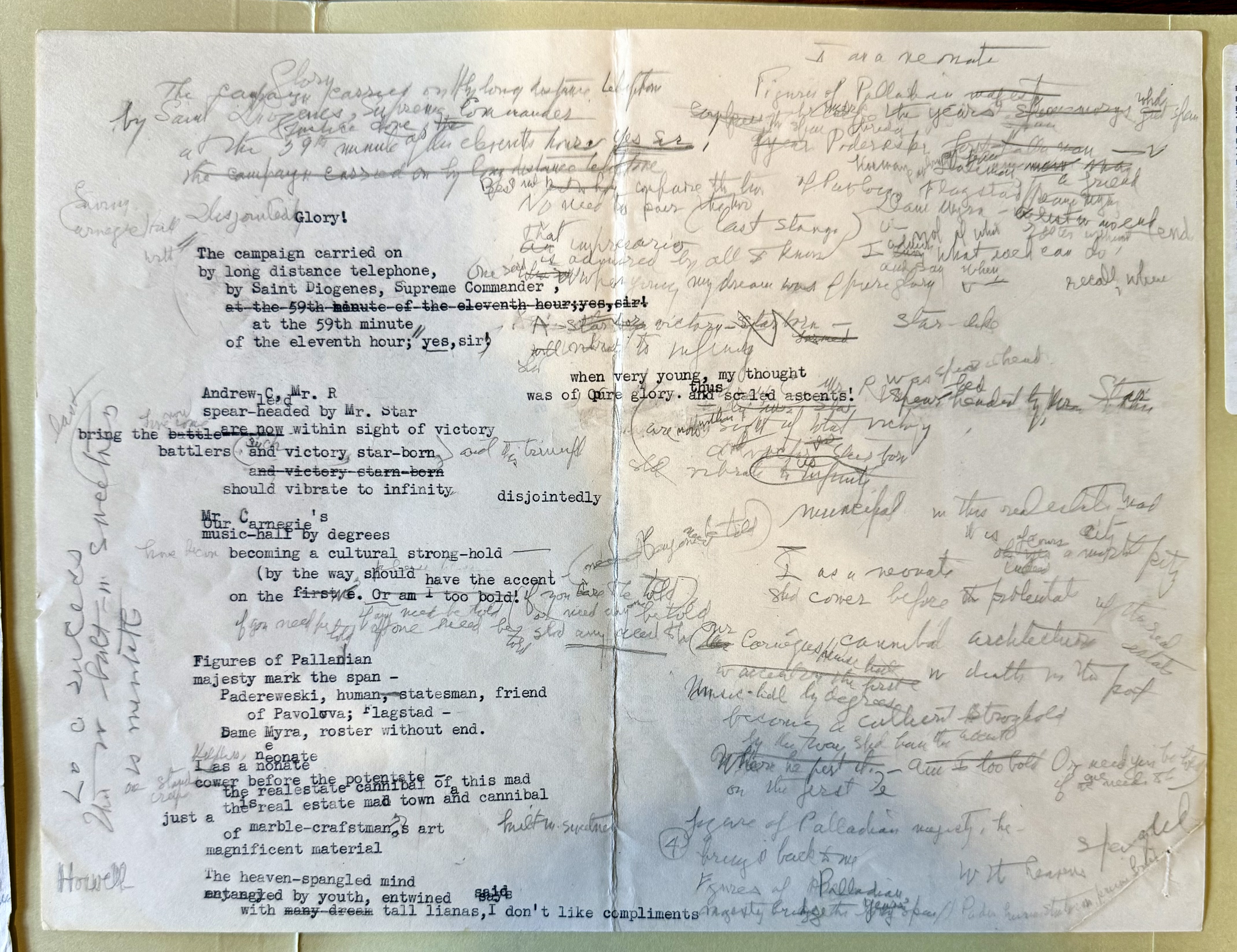
Moore's annotated typescript of Carnegie Hall Rescued
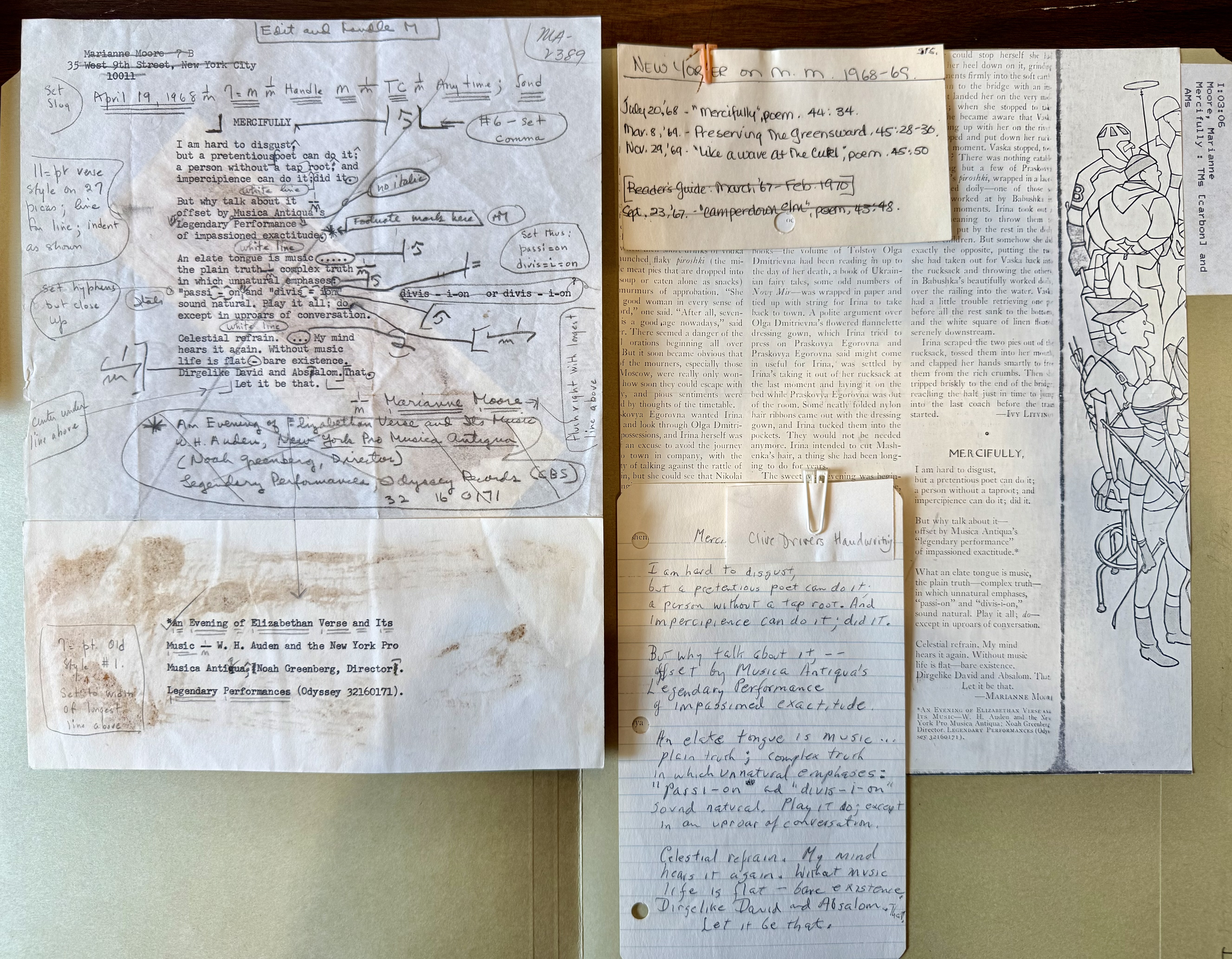
Moore's annotations on the typescript of Mercifully
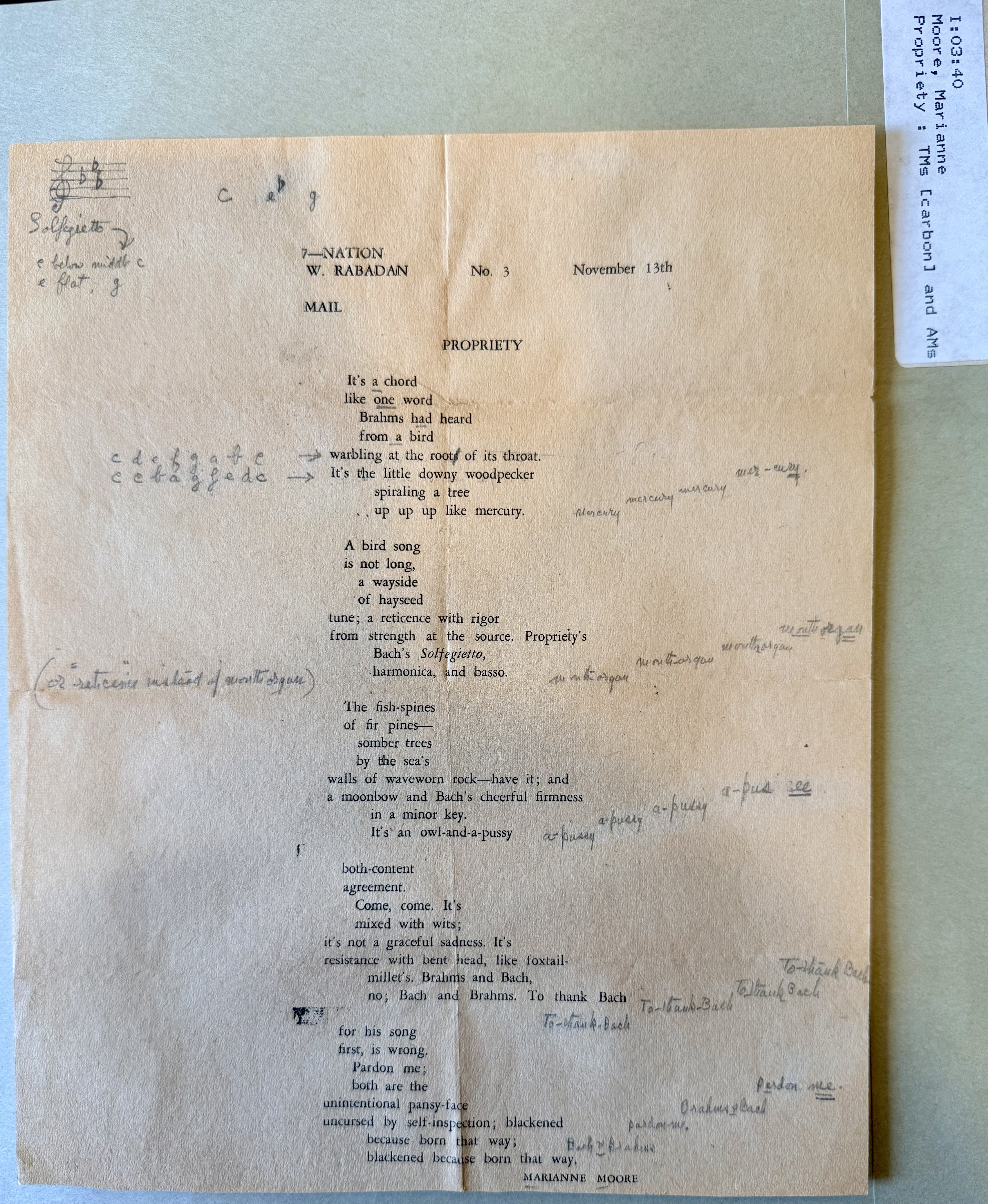
Typescript of Moore's poem Propriety for The Nation
All manuscripts, typescripts, and photographs shown are held by the Rosenbach Museum & Library, Philadelphia, and are reproduced courtesy of the Rosenbach for scholarly, non-commercial use.
More manuscripts & typescripts coming soon.
An unfinished, unpublished two-stanza fragment found among the typed drafts of An Octopus
01An unfinished two-stanza fragment recovered from the typescript drafts of "An Octopus." The lines survive nowhere in her published work, though the second stanza's coupling of music and tongue faintly anticipates "Mercifully" (no. 9).
A photo of a mountain goat Moore saw and preserved, the animal featured in An Octopus
02A photograph of a mountain goat preserved among Moore's papers — the animal that figures in "An Octopus."
Moore grouped The Steeple-Jack, The Plumet Basilisk, and The Jerboa as a trio to submit to Hound and Horn in 1933
03The title page on which Moore grouped "The Steeple-Jack," "The Plumet Basilisk," and "The Jerboa" as a sequence for submission to Hound & Horn in 1933.
Moore's submission of The Steeple-Jack to Hound and Horn
04Moore's submission typescript of "The Steeple-Jack," prepared for Hound & Horn.
The Plumet Basilisk Moore saw in the New York Herald and preserved, the animal is the main character of the titular poem
05A clipping of "The Plumet Basilisk" from the New York Herald Tribune, preserved by Moore — the creature at the center of the poem that bears its name.
How Moore read and knew of the ancient Egyptian artifacts she mentions in The Jerboa
06A source through which Moore studied the ancient Egyptian artifacts she invokes in "The Jerboa."
Moore's typescript of Bird-Witted, marking rhymes, rhyme scheme, and rhythm breaks
07A typescript of "Bird-Witted" annotated in Moore's hand, marking its rhymes, rhyme scheme, and rhythmic divisions.
Moore's extensively annotated and revised typescript of Carnegie Hall Rescued
08A heavily annotated and revised typescript of "Carnegie Hall Rescued."
Moore's annotations and revisions on the typescript of her poem Mercifully
09Moore's annotations and revisions on the typescript of "Mercifully."
Typescript of Moore's poem Propriety for the Nation, showing her annotations on rhythm and sound patterns
10A typescript of "Propriety," prepared for The Nation, whose annotations map with striking precision the rhythmic and sonic patterning of the poem.
Field Research · Ireland

Reading modernism and empire on site

Site visits in Dublin extended two strands of my research: the postcolonial and comparative work — at Trinity College Dublin and the National Gallery of Ireland — and the study of modernism and music, at the James Joyce Centre.

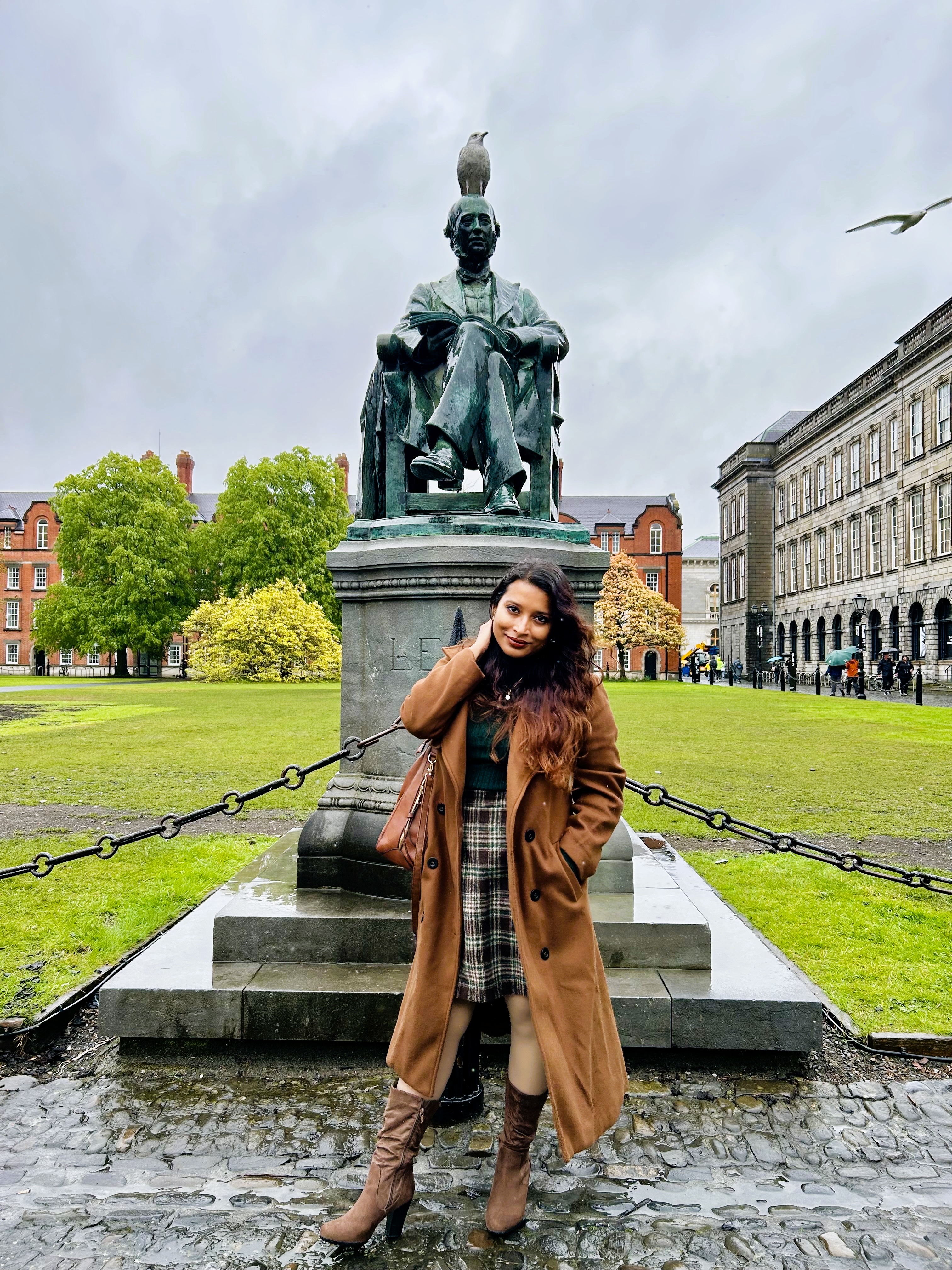
Amrita Bakshi at Trinity College Dublin
Trinity College Dublin
Postcolonial & comparative literatures — colonial famine, counter-hegemony, and the Anglo-Irish canon.
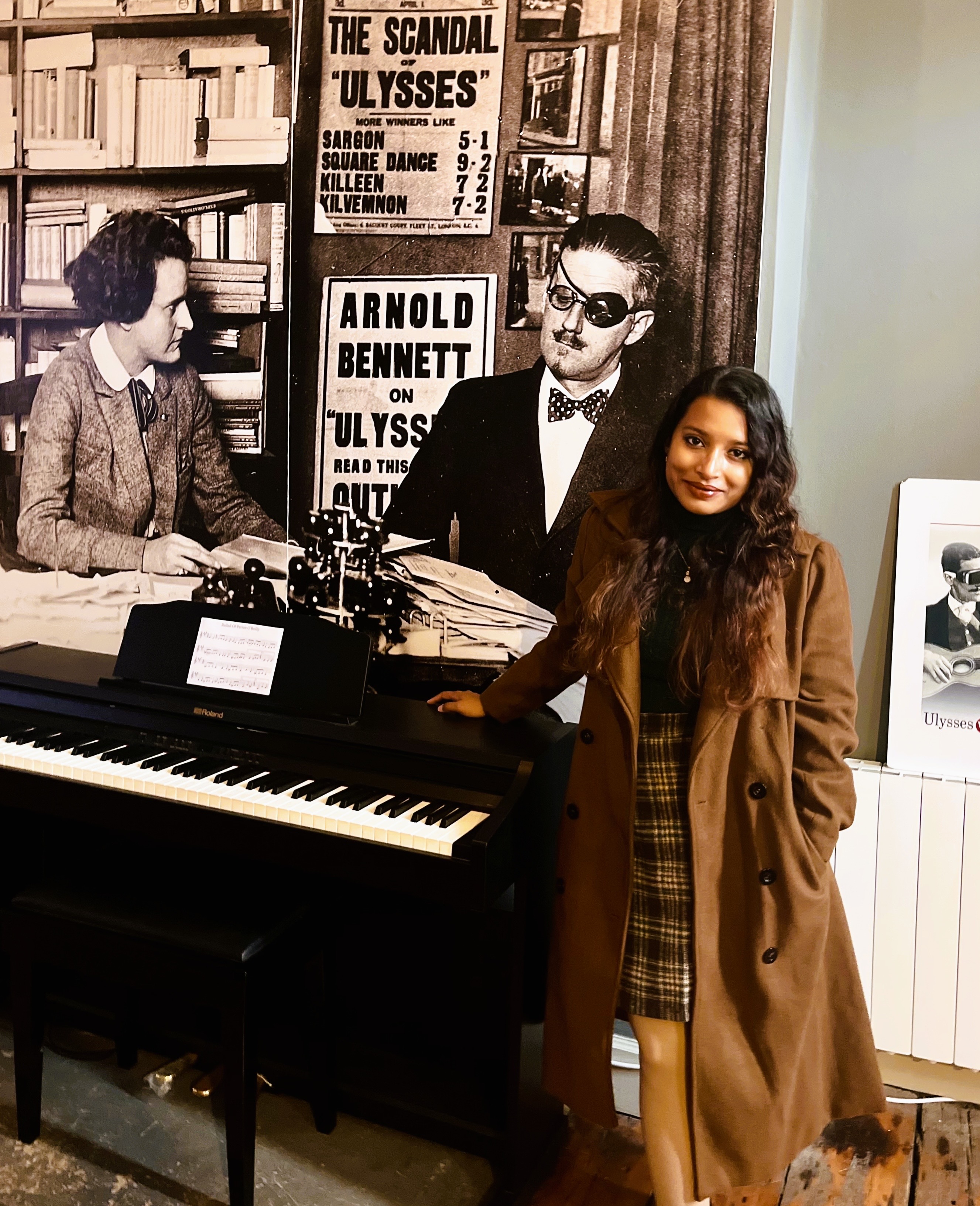
Amrita Bakshi at the James Joyce Centre, Dublin
The James Joyce Centre
Modernism and music — Joyce's Ulysses, the sung and spoken line, and the ear of the modernist text.
The National Gallery of Ireland · postcolonial visual culture
At the National Gallery of Ireland
Faculty Testimonials

On my research

Professor Steven Trout and Professor Heather White wrote these letters in support of my candidacy for the Outstanding Research by a PhD Student award, which I was honored to win.

Amrita was a student in my Spring 2023 graduate seminar on ‘Modernism, Place, and Gender' in the writings of Willa Cather. The students in that seminar were outstanding — among the finest I have encountered in my 30-year career — and Amrita was, in my estimation, the best of the bunch. From the very first day of class, she offered sensitive, well-articulated close readings and displayed a deep knowledge of American, British, and World literature. Her abilities, as a student of American literature and cultural history, are simply off the chart.

Her seminar paper, a groundbreaking analysis of the theme of ‘ennui' in Cather's A Lost Lady, was superb. She made all the scholarly moves one would expect of a far more experienced academic author. I know of no published work of scholarship that has approached A Lost Lady in this way. Over my career I have worked with hundreds of graduate students at three different institutions; fewer than ten of those students have Amrita's level of ability. I could not support her candidacy with greater enthusiasm.

Steven Trout
Professor of English · Graduate Students Advisor, The University of Alabama

This is a letter of strong support for Amrita Bakshi. I will be the supervisor of Amrita's dissertation when she begins work on it next fall. All of my experience of her work is of a born researcher. She arrived at graduate school a lucid, informed writer about literature, and she has evolved rapidly into a skillful and probing researcher. She has a sure feel for assessing the contours of a critical conversation and entering it productively.

Amrita is ambitious in the best sense of the word. She is industrious, focused, curious, and creative. She sets challenging timetables for herself and stays on them. Her first question about every piece of writing she does is, as it ought to be, how to bring it to a professional standard. She is right now the student one longs to have, and soon enough will be the colleague one dreams of.

Heather White
Professor of English · Dissertation Supervisor, The University of Alabama
Teaching

Teaching & mentoring

I approach the classroom as a space for critical thinking and cultural competence. Across five years as a Graduate Teaching Assistant at The University of Alabama, I have designed syllabi, led discussion, and mentored more than 150 students — teaching them to read closely, argue in writing, and engage seriously with literatures beyond the Eurocentric canon.

Amrita Bakshi
Teaching Philosophy

Teaching the process, not the product.

Amrita Bakshi presenting to her students

When I first began my teaching journey here at the University of Alabama, I was quite scared to teach classrooms full of foreign teenagers. I became ever so conscious of my ethnic and cultural identity as an international student from India. So, when I started teaching EN 101 in August of 2022, my teaching philosophy was about survival. However, I decided to use my personal cultural experience in my classroom, and I assigned diverse and inclusive texts like Yarn: An Interwoven Memoir by Pragya Bhagat, So Now You Know: Growing Up Gay in India by Vivek Tejuja, and Born a Crime: Stories from a South African Childhood by Trevor Noah. To my surprise, my students responded with great respect and genuine interest to my selected readings. Those readings sparked thoughtful and timely discussions about immigration, sexuality, and racial politics in the classroom, and I was thoroughly impressed by the brilliant, kind, and nuanced opinions from my students on these critical and even controversial topics. I felt I was succeeding at one of my primary goals: teaching my students how to think critically.

As a newly anointed teacher, even after building an initial good rapport with my students, I did face my fair share of challenges — mainly how to keep students engaged and motivated throughout the semester. To encourage more involvement, the first thing I started doing (and continue to do — it has become a teacherly habit by now) was individual check-ins, both on a personal and an academic level. We open class with a form of icebreaker, or “pass the mic” session, where each of my students shares where they are emotionally at the start of class. I have figured out that checking in does not have to be the most innovative of activities; it just needs to be genuine. I try to truly and deeply listen and engage in meaningful, sincere conversations. Deep listening helped create a welcoming environment where all my students felt empowered and comfortable to express themselves freely. This human approach, rather than a strictly teacherly one, helped me build easy and empathetic connections with my students — perhaps the most important of my teaching goals.

The academic check-in proved even more effective, because it highlighted the need to shift to a more process-oriented approach. These moments, during class time when my students are on task, helped me realise that both teaching and learning happen in direct, individual interactions. To hold the end-product — the papers students write — as the ultimate proof of learning is to deny the whole teaching-learning process itself. This realisation made me alter my lesson plans to include as much in-class working time as possible, which brought a marked improvement in engagement and a healthier, freer dialogue between me and my students. Focusing on the process instead of the product is, at this moment — when teaching itself is under the threat of an AI takeover — ever so necessary.

I now recognise that my role as a teacher is to teach my students how to think critically first, and then how to express those thoughts in a relevant medium or form. While AI tools like ChatGPT can probably write a paper in whatever form students require, it cannot yet become a surrogate thinker for them. Focusing on the process of thinking and writing, rather than on the final written artefact, will create both better writers and better thinkers. This is exactly what I aim to do in my classroom — by promoting diverse and inclusive pedagogy, teaching with empathy, and underscoring the central importance of the Process in all my teaching.

Courses Taught · The University of Alabama

What I teach, section by section

EN 101–103
English Composition I, II & Advanced Composition
Week-by-week syllabi aligning readings, assignments, and rubrics; discussion of multicultural and multiethnic perspectives; creative writing in an international English.
EN 208
World Literature II
Analyzing postcolonial and multicultural texts beyond the Eurocentric canon; engaging secondary criticism; producing research-based literary analysis.
EN 210
American Literature II
Close reading and argument through major American poets and movements — modernism, postmodernism, the Harlem Renaissance, confessional poetry — and interpretation of poetic form.
Tutoring & Mentoring
Athletic Tutor, Bill Battle Academic Center — Intro to African American Studies (AAST 201) and Intro to Listening (MUS 121).
Verbal Mentor, IMS Learning Resources (India) — SAT, ACT, GRE, and GMAT preparation and US admissions counseling.
Sample Materials

Lesson plans, lecture notes, and letters of support

Assignment sequences and assessment rubrics are available on request. Student Opinions of Instruction (SOI) surveys are collected below.
Student Opinions of Instruction (SOI) Surveys

Course evaluations, section by section

Official end-of-term course-evaluation summaries from my students at The University of Alabama.

In the classroom
Amrita Bakshi with her EN 103 students
Every student felt seen; every student knew that they mattered.
Students' Testimonials

In their own words

Amrita is undeniably one of the most compassionate professors I've had the pleasure of encountering. Her lectures were not just informative but also highly entertaining, often accompanied by engaging activities that made the learning process enjoyable. I had selected a controversial topic and was quite nervous, but from the very moment I shared it, she offered unwavering support and comfort — from the inception of my research until the completion of my project. Being a part of Amrita's EN 102 class brought me immense joy.

Morgan Calla · EN 102-125

Although this class was at 8am, I never wanted to miss a day. Ms. Bakshi was extremely attentive and excited to teach — she made the class atmosphere better than any other class I've ever taken. She made every student feel seen and heard, made long reading assignments fun, and explained each assignment in full detail. I learned so many valuable skills that will help me in my future professional life. For it being her first year of teaching, I would have guessed she had been teaching for at least 5 years.

Sydney Pearson · EN 102-107

I was so blessed to have Amrita as my EN 101 and EN 102 teacher. She made it very clear that she not only cared about our work and success, but also about us as people. She would assign us to a person in the class we had never interacted with before — she understands how important building a network is. She was always ready and willing to help: any email was responded to in less than 10 minutes, and she held one-on-one conferences over every single one of our essays. Amrita has been one of the best instructors I've had because of her unique teaching style, dedication to her students, and her never-ending love for learning.

Taylor Robinson · EN 101-112, EN 102-125
From student reflection assignments (EN 102)

You took time out to learn everyone's name and pronounce it correctly — you have real pride and patience for your job. I commend you also for being a student here yourself and teaching at the same time. Please never change your style of teaching.

Kayvis Wright · EN 102-107

I have learned and evolved a mass amount in my writing capability, research skills, and organization practices since the first day of class. She was willing to re-explain something we had already gone over, outside of class hours and while busy tending to her own priorities. Her act of benevolence was very impactful and greatly appreciated.

Kristopher Haygood · EN 102-107
Faculty Testimonials

From the Director of First-Year Writing

Letter of Recommendation · March 8, 2024

I can state unequivocally that Amrita's teaching places her among the top 10% of the 300 GTAs I have supervised over the last eight years. When I observed Amrita teach, I found that in many respects she worked like a veteran. She encouraged reflection, monitored her students' progress, offered individualized coaching when needed, and held her students accountable. She maintained a calm, caring classroom environment, calling on students by name, listening closely to their contributions, and providing encouragement and constructive criticism. Every student in her classes felt seen; every student knew that they mattered.

Amrita's students responded in kind, noting on their SOIs that she was “understanding,” “accommodating,” and “accessible.” It's no surprise that her course and instructor ratings range from 4.6–4.89, well above department, college, and university means. Amrita has a keen sense of professional humility — she distinguished herself as an active student of her own teaching. Nothing was too small for her to question: seating arrangements, absent students, grading. For Amrita, the classroom is a perpetually rich and re-readable text. The best teachers understand this. I therefore give Amrita Bakshi my highest recommendation.

Luke Niiler
Director of First-Year Writing · Associate Professor of English, The University of Alabama
Faculty Teaching Observation
EN 101 · TH 103 · March 30, 2022 · observed by Luke Niiler

You had chairs arranged in a circle at the start of class, which began promptly at 9:30. You had the day's agenda written on the board: pass the mic, artists' statements, peer review, and PQP. Students seemed to have a solid grasp on their topics and a good sense of what they'd learned from their research. I appreciated the rich variety of topics in play — and the ‘lateral' conversation between students as they shared their reflections. Many seemed genuinely interested in their classmates' topics and findings.

At 9:51 you switched to artist's statements, asking students to reflect on what they did well, what they could have done better, and their takeaways. You held an ambitious student accountable, asked him to help a classmate, and took the time to circulate — moving out from behind the lectern, another form of encouraging student accountability.

At 10:09 you moved to peer review, telling students to work with new partners and to be ‘honest but kind,' which you framed as a useful life skill. As chatter ensued, you reminded students of the limited time and the grade value of the assignment. As they got down to work you circulated, coaching, creating a welcome sense of exigency, and reminded them to store their materials for a later reflection.

At 10:29 you moved on to PQP — praise, question, polish — asking students to write anonymously on index cards, which you'd review before the next class. You set up the remix unit nicely and demonstrated a palpable confidence and ease. Class dismissed at 10:41; you remained behind to consult with a student.

Your class had a great deal going for it: you encouraged reflection, monitored your students' progress and held them accountable, and wisely had your students working face to face, sitting in a circle. You demonstrated a palpable confidence and ease. You are doing good work. Ease is hard-earned, but you are earning it.

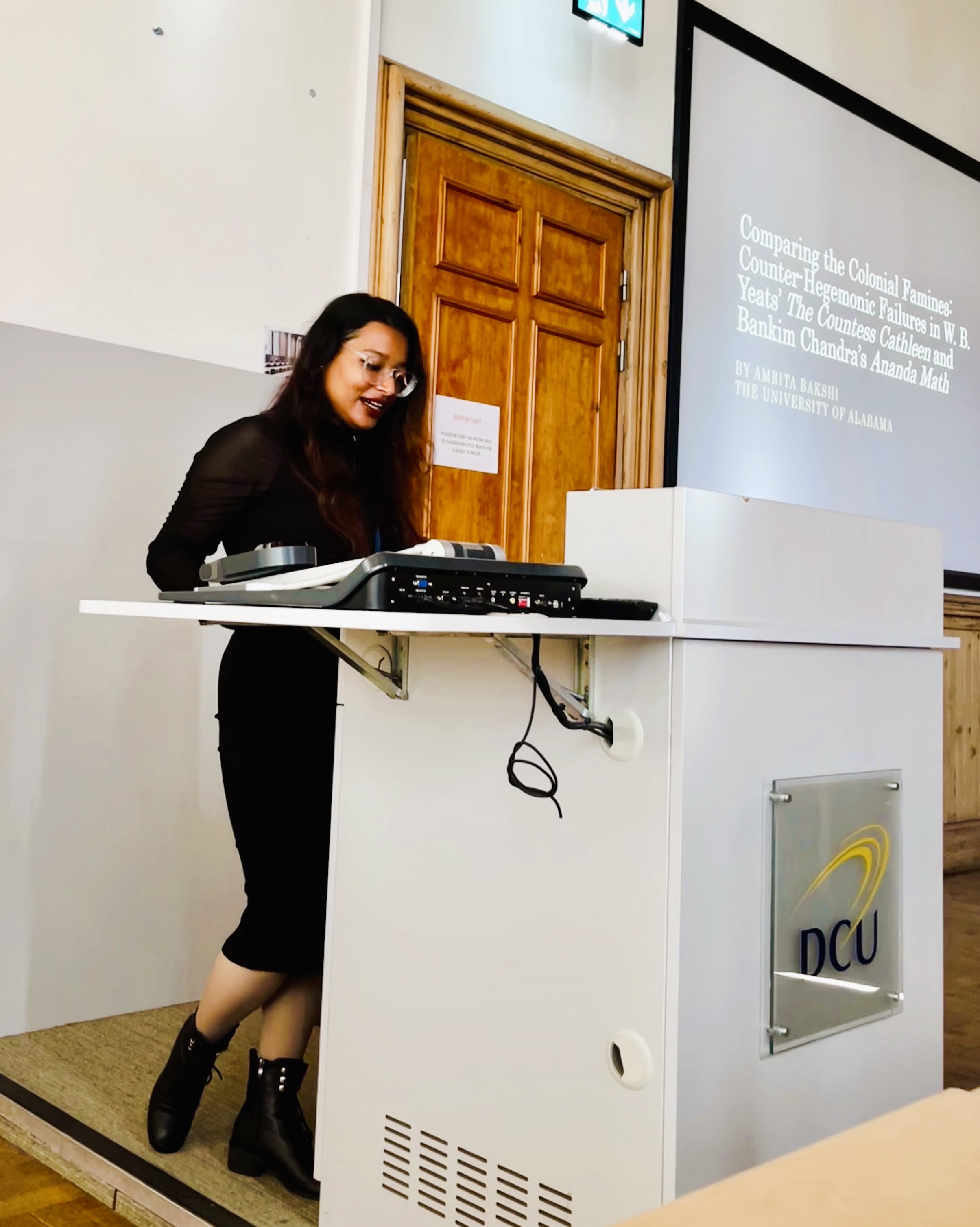
Amrita Bakshi presenting at Dublin City University
Publications & Talks

Writing & scholarship

Peer-Reviewed Articles
2024
"Modernist Ennui and the Use of Domestic Time in A Lost Lady." Willa Cather Review 65.2 (Summer 2024): 12–17. PDF ↗
2026
From the Podium

Moments of engaging with my peers and the wider academic community — presenting research, sitting on panels, and moderating conversations across three countries.

On the panel at Dublin City University
On the panel — 8th Annual South Asia Conference, Dublin City University · April 2025
Presenting at Dublin City University
Presenting “Comparing the Colonial Famines” — DCU
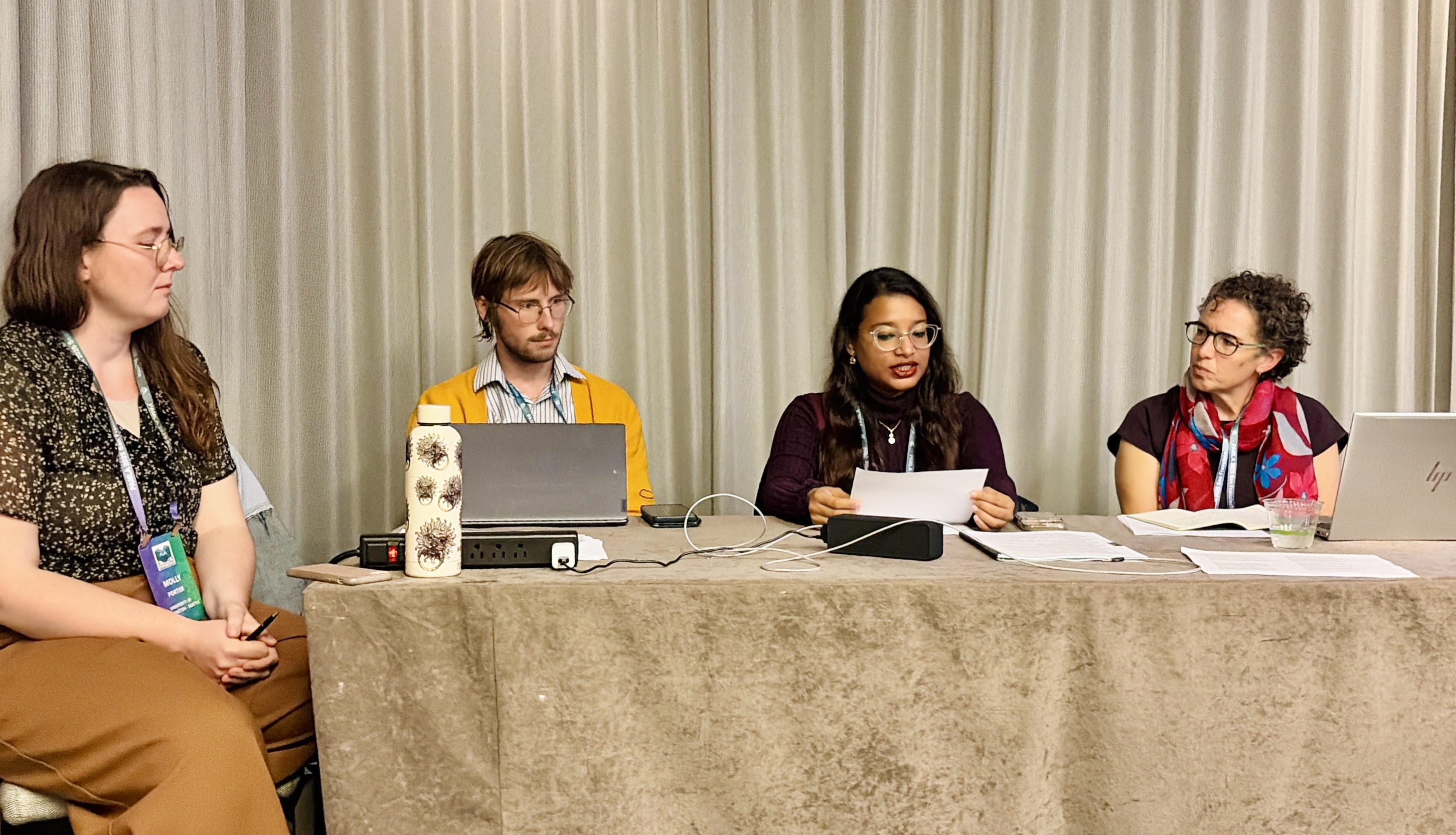
Reading my paper at the ACIS conference
Reading my paper on my panel — ACIS & BCPS Shared Conference, Savannah
At the CUNY Graduate Center
CUNY Graduate Center, after CLAGS: Queer-Class Relations — New York City · 2026
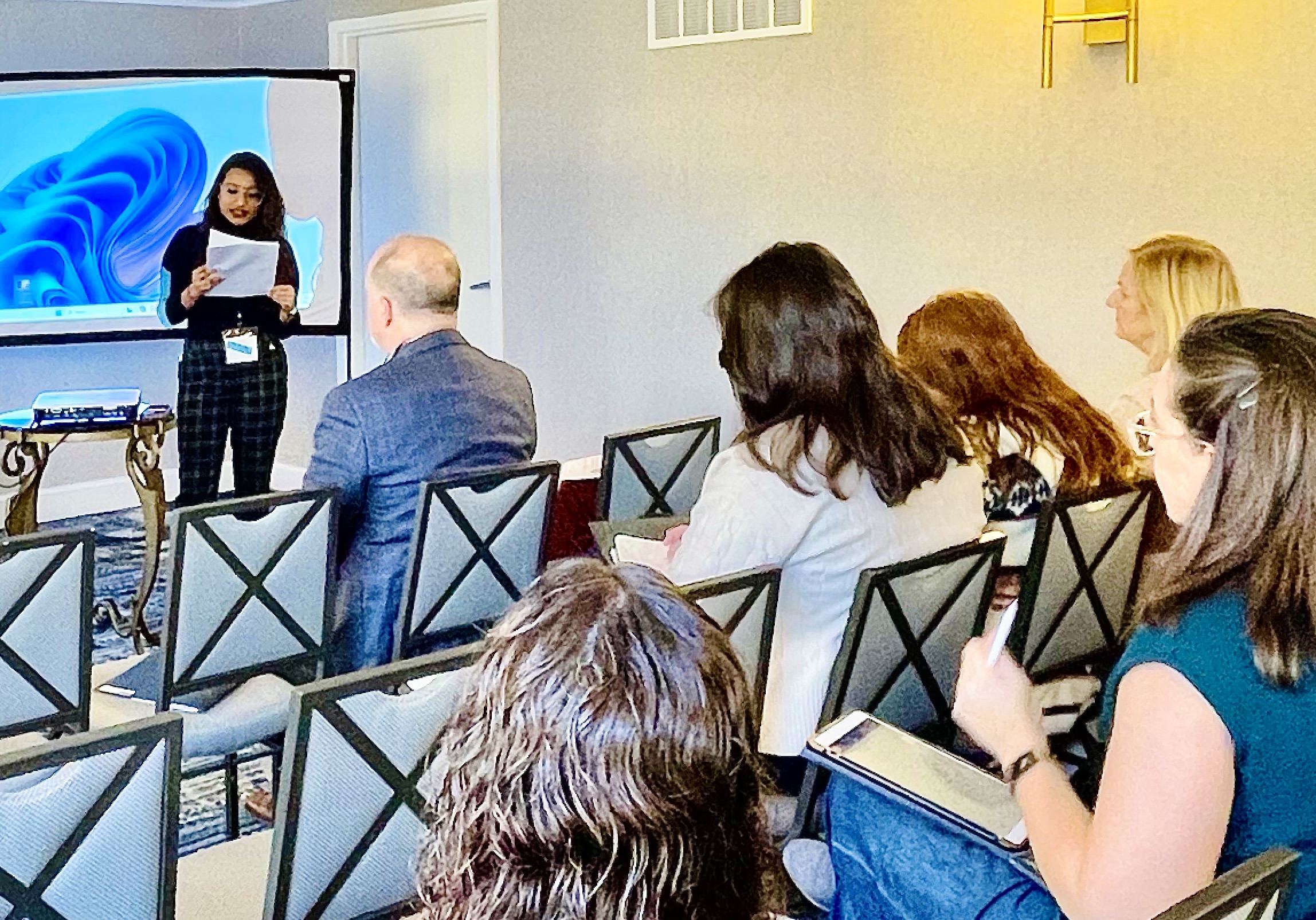
Moderating the UA faculty panel
Moderating the faculty panel on academic editing — UA Department of English
Amrita Bakshi presenting at PAMLA
Presenting “Impact and Exactitude: Musical Intentions in Marianne Moore’s Poetics” — PAMLA, San Francisco · 2025
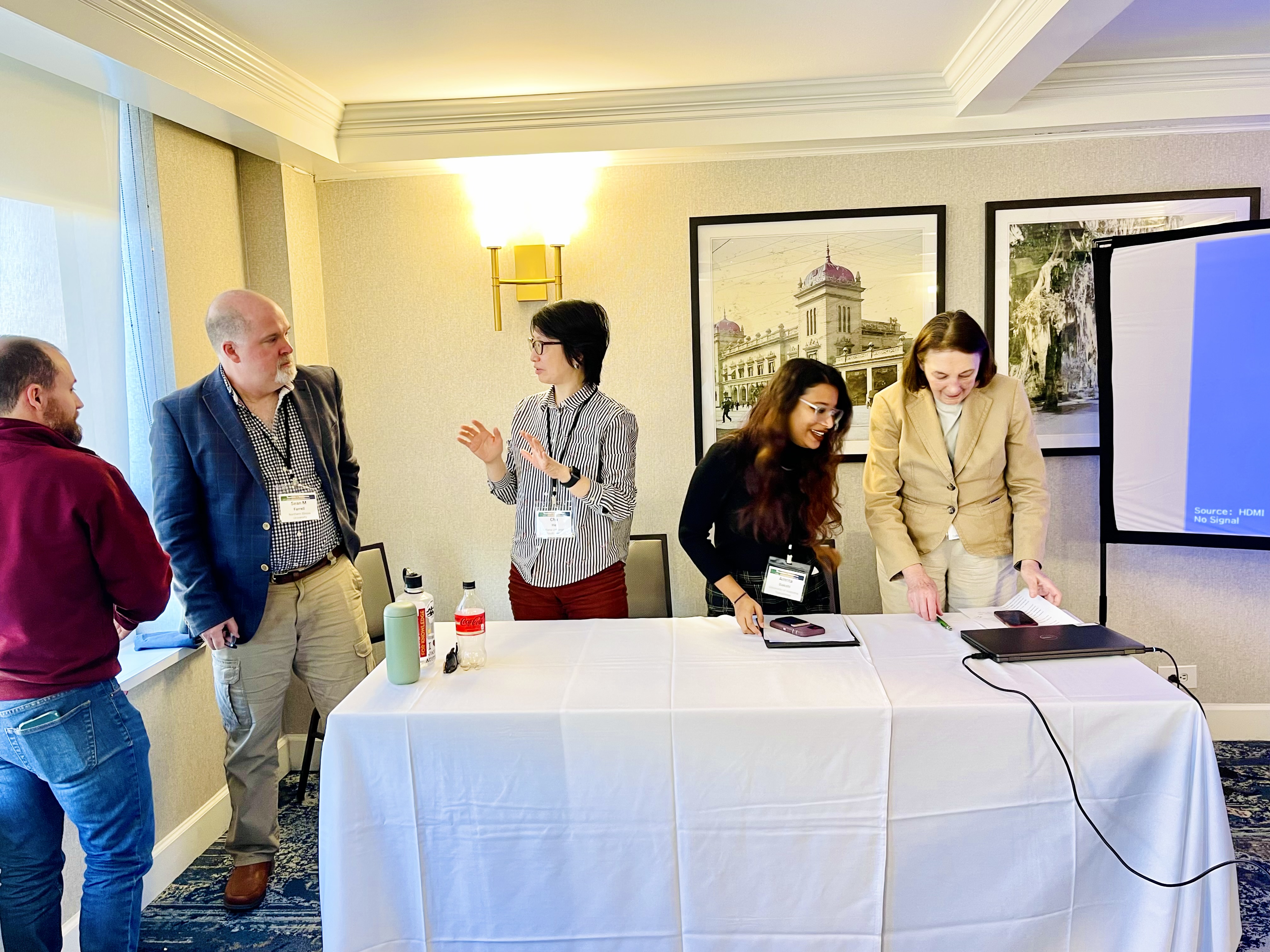
With my panel at the ACIS conference
With my panel — ACIS & BCPS Shared Conference, Savannah, GA
Conference Presentations & Invited Talks
{{ t.date }}
{{ t.title }} — {{ t.venue }}
{{ t.abstractLabel }} {{ t.linkLabel }} {{ t.linkLabel }}
{{ t.abstract }}
Editorial Work
2022–24
Assistant Poetry & Fiction Editor, The Black Warrior Review — issues 49.1, 49.2, 50.1, 50.2
Amrita Bakshi on the coast
Recognition & Community

Awards, service
& creative work

Awards & Achievements
{{ a.year }}
{{ a.text }}
Leadership & Service
{{ s.year }}
{{ s.text }}
Creative Activities
Amrita Bakshi before a street mural
Poet and photographer as much as scholar — my creative practice moves between the written line and the image, and has been shown in gallery exhibitions and collaborative storytelling.
01
Plate 01 · September 2024
Scheherazade's Choir
Original poetry and photography exhibited at the Sella-Granata Art Gallery.
Poetry & Photography
Curator · Funmi Omo Moji
Watch the reading ↗
Exhibited poemSonnet
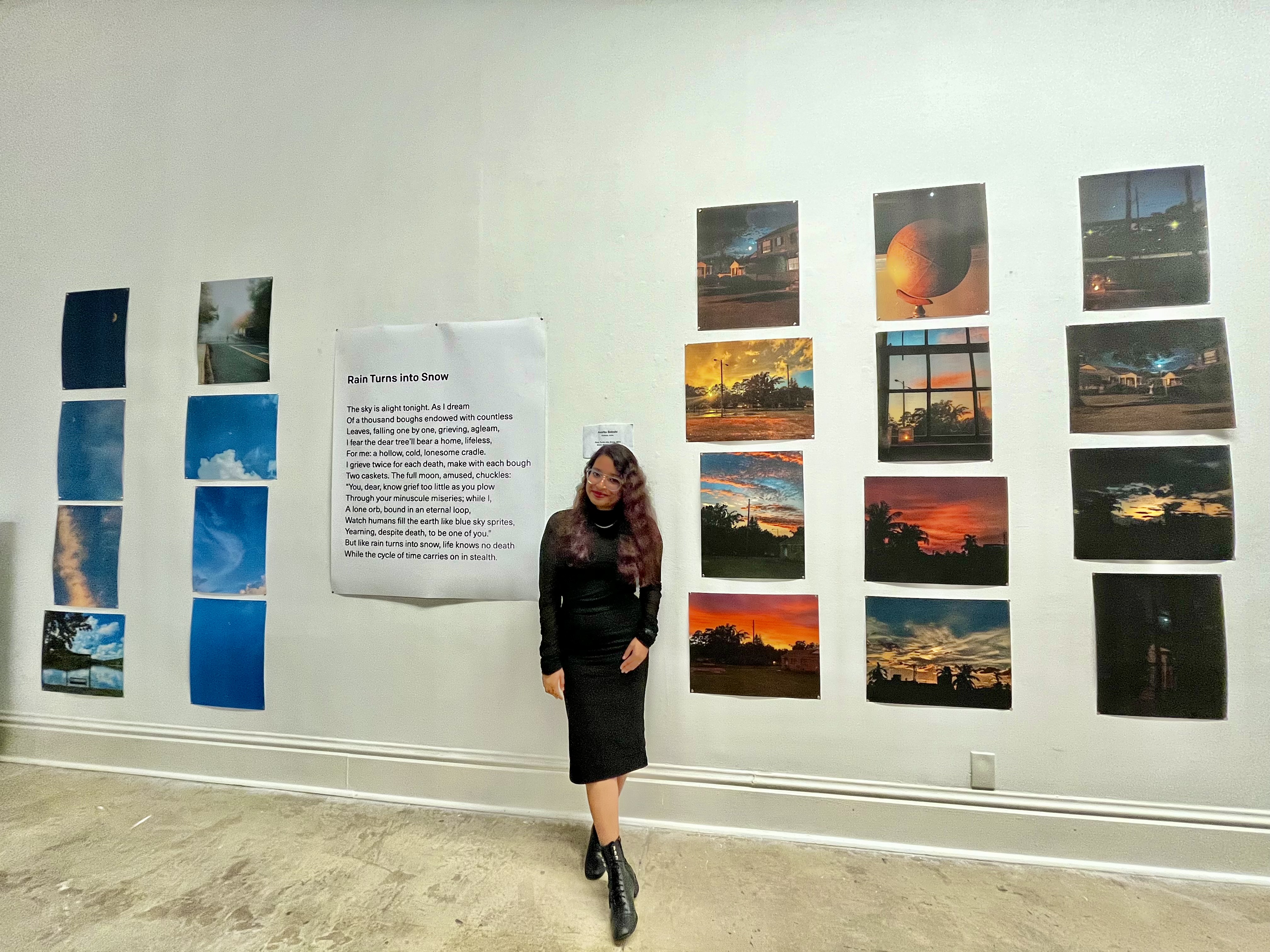
Rain Turns into Snow
The sky is alight tonight. As I dreamOf a thousand boughs endowed with countlessLeaves, falling one by one, grieving, agleam,I fear the dear tree'll bear a home, lifeless,For me: a hollow, cold, lonesome cradle.I grieve twice for each death, make with each boughTwo caskets. The full moon, amused, chuckles:“You, dear, know grief too little as you ploughThrough your minuscule miseries; while I,A lone orb, bound in an eternal loop,Watch humans fill the earth like blue sky sprites,Yearning, despite death, to be one of you.”But like rain turns into snow, life knows no deathWhile the cycle of time carries on in stealth.
Hover to read · tap a line to keep it lit
Poet's Reflection Turning rain into snow — transmuting grief into wisdom through three progressively expanding perspectives. Read the full account ×
Poet's Reflection Turning Rain into Snow Transmuting grief into wisdom through three progressively expanding perspectives — the human, the moon's, and Time's.

It was a chilly February afternoon; I was walking back home from campus. It was drizzling but a very strange thing happened by which I — never having seen snow in my life before coming to Alabama — was pleasantly surprised: the rain drops were turning into snow just before reaching my open palm. This image stayed with me, and that night when I sat down to conceptualise the sonnet I was assigned to write, it serendipitously fit the sonnet's metaphorical structure. As an exercise in understanding grief, the poem becomes enriched by the metaphorical significance of rain (as tears) transforming into snow (as wisdom that comes from a higher understanding of death). This, therefore, is my attempt at transforming my own grief into poetry.

The easiest part was choosing the central theme: grief — literally at the centre of the sonnet, in the middle of the eighth line. Having lost my father and both my grandparents in the same year, grief became a part of my emotional existence. I eventually found my own way of coping: shifting from a human perspective to a cosmic one, watching videos about the vastness of space that put my infinitesimal existence into perspective. I render this in the sonnet's three shifting perspectives — the human, the moon's, and finally that of Time.

I wrote the sonnet as a short story about a conversation between a person and the moon, opening in a third-person narrator's voice (“The sky is alight tonight”) that shifts into the first person (“As I dream…”). To the person, grief is the fear of losing loved ones: the conceit of the “tree” — “a hollow, cold, lonesome cradle” — hints at losing one's parents, and one grieves twice: once fearing a death, and once when that fear comes true. The “tree” of “a thousand boughs” becomes the family tree, though read as the “tree of life” it offers a deeper, more consoling understanding of life and death.

To show three perspectives, I included two voltas. Following the Petrarchan structure, the first turn falls in lines 7–8, where the moon — personified, and lonely as the only moon — views all humans as a community it longs to join: “Yearning, despite death, to be one of you.” The image of “blue sky sprites” captures this cosmic view: from above, humans are tiny and transitory, and so are their griefs.

For the second volta I followed the Shakespearean couplet. Influenced by Walt Whitman's idea of life as a transformative cycle rather than a linear process, I offer a resolution by erasing death altogether: “But like rain turns into snow, life knows no death / While the cycle of time carries on in stealth.” From Time's perspective there is no death — one energy is simply transformed into another, exactly like rain becoming snow rather than vanishing. Where “snow” often symbolises death, here it becomes the next state of existence; I gave each couplet line eleven syllables (against the sonnet's usual ten) to mark this higher truth.

The tricky part was merging form with function. I did this mainly through internal rhymes and enjambments. Following a straightforward Shakespearean scheme (abab cdcd efef gg), I let the first movement — human grief — be the busiest in internal rhyme and punctuational pause, echoing the bouts of sobbing one feels while grieving; as the perspective shifts, that frequency steadily decreases. Inspired by Miltonic verse, I built the early lines with jerky, enjambed syntax that smooths as the poem approaches its tranquil destination.

Writing this sonnet made me far more appreciative of the craft — of the poet's intelligence in integrating form with function. Now that I have built a sonnet syllable by syllable and rhyme by rhyme, my first instinct when reading one will be to trace its syllabic and rhyming patterns and ask whether they answer its themes.

Amrita Bakshi · 7 July 2023
02
Plate 02 · April 2022
“New Myths for a Dying World”
Original poetry exhibited at the English Building as part of a collaborative storytelling.
Collaborative Storytelling
Curator · Funmi Omo Moji
Watch the storytelling ↗
Exhibited poemSonnet
To The Universal Being
I command you all to contain at onceAll the selves inside your microcosm!Why let’t be a choice you only pick onceAnd regret thrice for a life abandoned?Let’s have the flower and the pricking beeAnd the whole landscape inside you that’ll beWaiting in for your blood to boil or chillSo that it sprouts pride for eternity.So, I’ll annihilate flesh and produceA new abode and then, I will consumeOlden essence to bring forth truly fusedA bodily existence built for youTo live a universe of expression.Fear me, adore me, revere my mission.
Hover to read · tap a line to keep it lit
Amrita Bakshi with curator Funmi Omo Moji
With curator Funmi Omo Moji
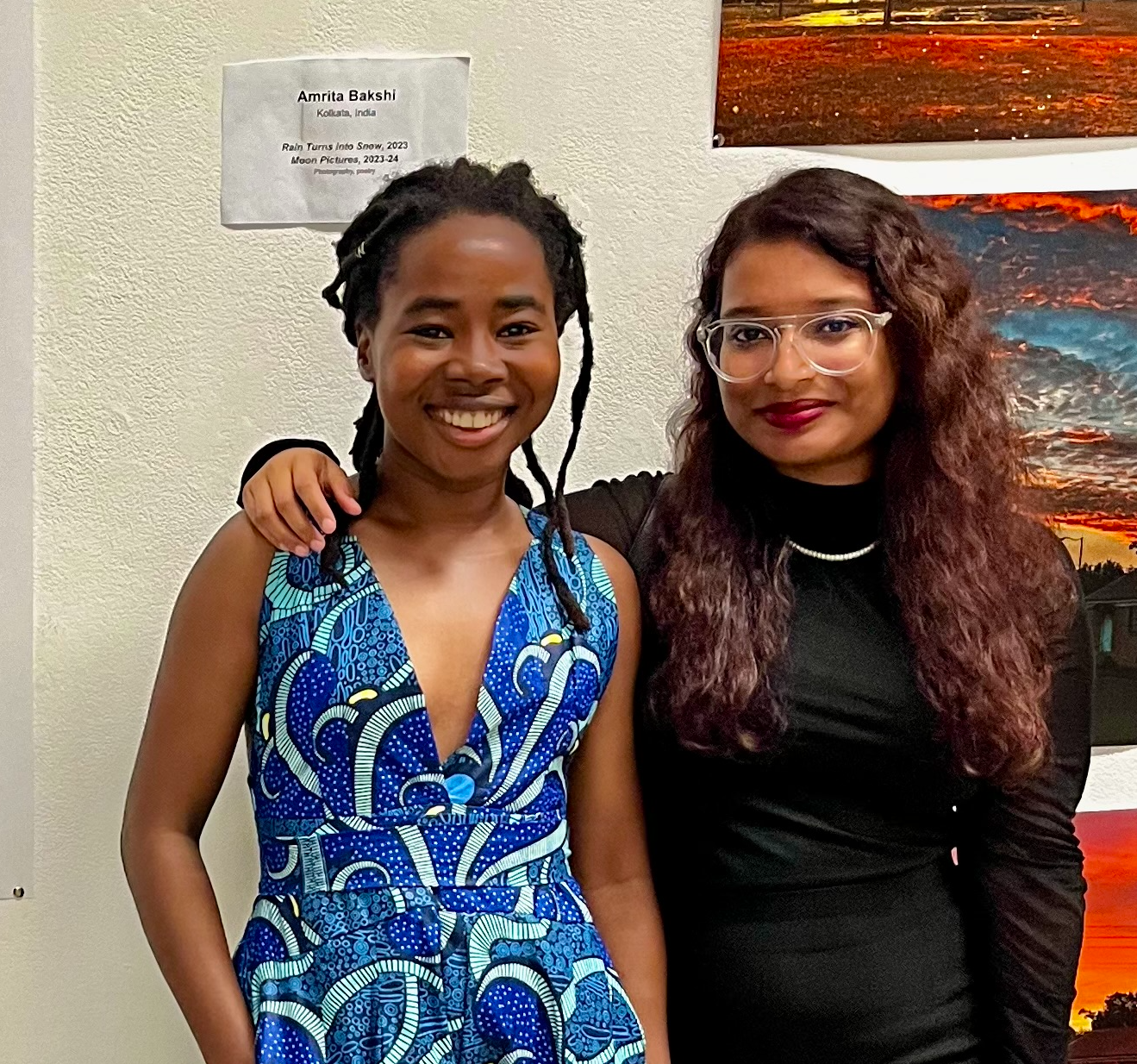
Amrita Bakshi beside her exhibited poem Rain Turns into Snow and her sky photographs
With Rain Turns into Snow and my sky photographs
Contact

Get in touch

I welcome conversations about research, teaching, and collaboration — and inquiries from search committees. The fastest way to reach me is email.

Emailabakshi@ua.edu
DepartmentDepartment of English, The University of Alabama, Tuscaloosa, AL
Amrita Bakshi
Amrita Bakshi · PhD Candidate in English Literature · The University of Alabama
EMAIL UA PROFILE ORCID CV